By Andy Szybalski, Co-Founder, Tradewinds School
You've probably used an app I helped build. I led product design for Google Street View and co-founded Uber Eats. More recently I spent three years building an AI startup called Cove, until our team was hired into Microsoft. Two decades of that work taught me what thoughtful software can feel like. Plenty of software for grownups is awful, but the industry has at least proven that software can be powerful, elegant, and humane: maps that help us understand a city, tools that let teams collaborate across continents, creative apps that let an amateur make something that used to require a professional.
That history is exactly why I felt such dismay when I looked at what my own son was being handed at school, and at what children are handed generally.
The software made for children too often feels janky and under-designed. The interfaces are clumsier than what we build for adults, the underlying assumptions about the user are thinner, and the intellectual ambition is lower. A child notices this, even when they can't name it. Software that treats a kid as a clicker to be kept busy is, quietly, a failure to take that kid seriously.
Progressive educators should care about the design of their software as much as they care about the design of their classrooms. And for the first time, we can finally do something about it.
WHO THE SOFTWARE IS REALLY FOR
The poor quality of children's software is partly a market problem, and the market problem is worth understanding before we blame any individual product.
In workplace and consumer software, users have gained real leverage over the last two decades. Employees are also consumers; they bring consumer-grade expectations into the office, complain loudly when their tools are miserable, and increasingly assume that software should be fast and pleasant. Companies that ignore this lose their users and eventually die. That pressure, applied relentlessly over years, is what produces good software.
Children have almost none of that leverage. They rarely choose their tools, rarely pay for them, and have no real channel to say "this experience is not worthy of me." In school software, the person who selects the product is never the child, and often not even the teacher. It may be a district office, a procurement committee, or a technology department.
Those buyers have legitimate concerns. They worry about privacy, reporting, integrations, support, standards alignment, budget, and implementation risk. But those concerns are different from the concerns a child has while learning, or a teacher has while trying to build a meaningful experience. When the buyer and the learner are different people, products get optimized for the buyer: compliance, dashboards, feature checklists, easy demos, and procurement safety. The classroom experience itself becomes an afterthought. No single actor here is behaving foolishly; each one is responding rationally to its own incentives. The result is software built to satisfy the buyer rather than to serve the child.
Then there is a second problem layered on top of the first. Many "educational" apps are Candy Crush in a school costume, full of gems, streaks, badges, and a constant blizzard of microinteractions. Delight is not the enemy here. The trouble is that the delight is usually attached to the reward machinery rather than to the intellectual work. The software surrounds a child's curiosity with noise and trains them to care about the points instead of the thing the points were supposed to represent.
Progressive education starts from a different premise. It assumes children are thinking, feeling, meaning-making people whose questions and attention matter. Software that treats them as clickers and completers is teaching a philosophy of education whether we intend it to or not.
TECHNOLOGIES ARE NOT VALUE-NEUTRAL
That last point deserves to be made plainly, because it is the heart of the argument: the tools we adopt carry values, and those values get absorbed into our practice.
Winston Churchill made the point in 1943, arguing to rebuild the bombed-out House of Commons in its original cramped, adversarial shape. "We shape our buildings," he told the House, "and afterwards our buildings shape us." Technology works the same way, often in ways its makers never intended. Email flattened some workplace hierarchies by letting anyone contact anyone. Social media rewarded outrage and immediacy over thoughtfulness. Standardized testing rewarded whatever could be measured cheaply at scale. None of these effects were neutral, and none were fully chosen.
Values can also be built in on purpose. In the idealistic early days of the Internet, Craigslist stayed deliberately plain and mostly free, declining the advertising and engagement tricks that every incentive pushed it toward; its design reflected a clear decision about what the tool was for.
The software we put in front of children reflects decisions too, whether we make them deliberately or inherit them by default. Software built around standards coverage makes coverage feel like the purpose of learning. Software built to raise test scores makes test-shaped thinking feel like the goal. Streaks and badges pull a child's attention toward the reward layer. Dashboards make whatever is visible to an administrator feel more important than whatever is meaningful to a child or a teacher.
Assessment is the clearest example. When software treats assessment as a separate event that happens after the learning, it quietly contradicts one of progressive education's core insights, which is that assessment is most powerful inside an ongoing dialogue among teacher, child, peers, materials, and environment. A tool that saves assessment for the end is making a pedagogical claim, even if no one at the company ever thought of it that way.
OUTSOURCING PEDAGOGY
Once technology becomes a large part of the school day, choosing a tool stops being an operational matter and becomes a pedagogical one.
The tool you adopt defines what counts as progress. It decides what feedback looks like, when to reward or correct, and when to move on. It sets the rhythm of the experience, and it can make learning feel like a genuine conversation or like a sequence of disconnected tasks. When those decisions are made by a company whose incentives and educational philosophy do not match the school's, contradictory values seep into the learning experience.
A school can believe deeply in Dewey, in inquiry, in reflection, and in child-centered learning, while the software running quietly underneath the school day teaches something entirely different. A progressive teacher assigning a behaviorist app does not make the app progressive. The worldview baked into the tool comes along whether the teacher wants it or not.
For a long time, schools had little choice about this. Building custom software required engineers, budgets, and infrastructure that almost no school could access, so even a school with a powerful pedagogical vision had to pick from whatever the market offered. That constraint is now lifting, and that is the genuinely hopeful part of this story.
AI CHANGES THE COST OF BUILDING SOFTWARE
The cost of building software is collapsing, and faster than most people outside the industry realize. Anthropic, the company behind Claude, now expects that nearly all of its own code will be written by AI by the end of the year. Its new product, Claude Cowork, went from a blank page to a public launch in ten days. These are not toy demos. They are real software shipped by one of the most sophisticated engineering organizations in the world, built at a speed that would have been impossible eighteen months ago. As Boris Cherny, who created Anthropic's AI coding tool Claude Code, put it: "I feel a lot of things changing as working software increasingly comes out on a tap." One such change is that schools can become creators of technology rather than passive consumers.
I have been living this trend. I'm a co-founder at Tradewinds School, a new K–8 school in Honolulu opening this August (much more on the school below). We've gone from idea to opening in eight months, closer to a startup timeline than a school one. Along the way, I single-handedly built a new learning platform called Rabbithole from the ground up to match our school's educational approach.
We have not reached "anyone can build anything" yet. But we are getting closer to it every month.
Humans have lived through this kind of shift before, more than once. Gutenberg's press freed the book from the scribe's hand and let knowledge escape the monastery. Owning a press was still expensive, its own kind of gatekeeping, until Tim Berners-Lee built the web and gave it away, with no patent and no license fee, so that anyone with a connection could publish to the world. A generation of writers, makers, and small businesses appeared who would never have made it past a gatekeeper. The press did this for books, the web did it for publishing, and AI is now doing it for software. The cost of building a real application is falling the way the cost of reaching an audience once did, and the people it lifts up will be the ones who were priced out before, schools among them.
The consequence for schools is significant. A technically fluent educator or a small school team can now build, adapt, or fork the tools they need rather than choosing among the products a vendor decided to sell. Schools no longer have to pick between bad tools and no tools at all. AI is not only a classroom technology that schools must react to. It is also the thing that lets schools take back control of their software environment.
AI IS NOT CHATGPT
Many educators still understand AI as ChatGPT, a general-purpose assistant in a blank text box. You type a question and it hands you an answer. That default experience is a particular product decision rather than the nature of the underlying model.
The model is the engine. The educational behavior comes from everything wrapped around the engine: the prompt, the interface, the structure of the activity, the controls available to the teacher, the feedback loops, the data boundaries, and the values the school encodes into the tool. The same model can be an answer machine or a Socratic questioner, a reflection partner or a formative-assessment observer, depending entirely on how it is designed.
So the right question for a progressive educator is not "do we want ChatGPT in our school?" That framing is too narrow to be useful. The better question is what roles, if any, AI should play inside a progressive learning environment, and who gets to design those roles. The answer to the second half of that question should be the educators themselves.
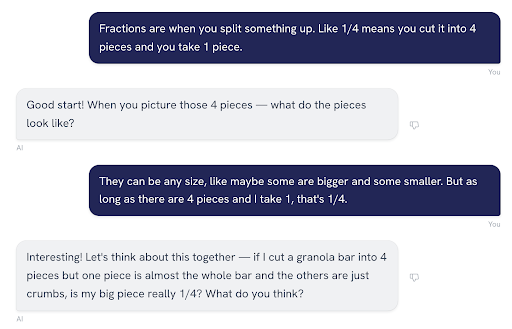
Rabbithole’s AI tutor engages in Socratic dialogue with students, based on a system prompt that defines its overall approach, as well as an activity-specific prompt crafted by the teacher.
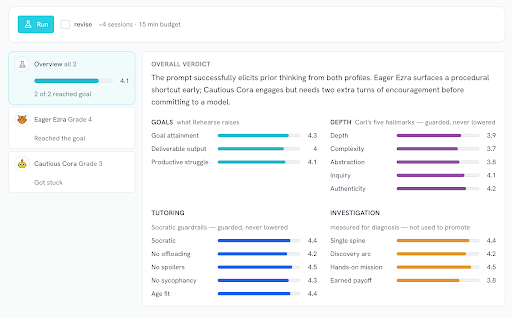
While designing their script, teachers can “rehearse” it with simulated students to judge its effectiveness.
WRAPPING CONVERSATION AROUND EXPERIENCE
Used carelessly, AI hands over answers and accelerates the cognitive offloading that researchers are increasingly worried about. Used well, it can help a teacher extend their presence and judgment across the moments when they cannot be everywhere at once. The structure we keep returning to wraps a short digital conversation around a real, off-screen experience, with the experience always at the center.
The system supports the experience rather than prescribing a fixed sequence of steps. The unifying idea is metacognition: at a few points across a lesson, a unit, or a longer project, a short AI conversation can help a student see their own thinking more clearly, and the teacher reaches for it only where it serves the lesson. Before an offline lesson, a conversation could activate what a student already knows, surface their questions, and ask them to predict what will happen, so they arrive with a problem already in mind. In the middle of an investigation, it could ask a student to pause and name what they are stuck on, or why they expect their approach to work. Afterward, it could help a student work out what surprised them, what shifted in their thinking, and what questions remain. And across a whole class, it could gather those predictions and reflections into a guide for the teacher that highlights common misconceptions, the strongest student ideas, and the tensions most worth opening up in discussion. The real, off-screen work — running the experiment, debating the text, planting the garden bed, building the thing — always stays at the center, and the AI earns its place only when it makes that work richer.
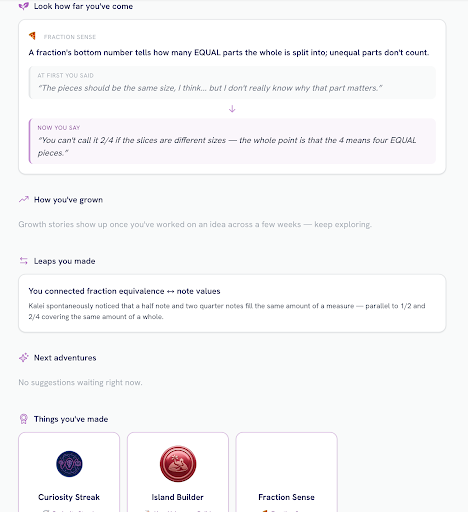
Rabbithole’s “My Learning” view encourages the student to reflect on their own progress, and invites a dialogue about what’s next.
Tradewinds draws on several traditions, and this loop is where a few of them meet. From Montessori we take the prepared environment and the guide who observes closely and intervenes lightly, trusting the child to do real work with real materials. From Renzulli we take the conviction that serious learning starts from a student's genuine interest and leads toward real investigation rather than rehearsed exercises. From Annemarie Roeper we take attention to the child's inner life, the belief that a young person reflecting on how their own thinking changed is doing some of the most important work a school can ask of them. And from Dewey, the philosopher this community knows best, we take the insight that experience becomes educative through reflection. Dewey did not mean "learn by doing" in the shallow sense the phrase has acquired. In How We Think he defined reflective thought as the active, persistent, and careful consideration of a belief in light of its grounds and consequences, and in Experience and Education he argued that the teacher's real work is shaping experiences that lead somewhere worthwhile.
The AI never replaces the lived experience at the center. It strengthens the conditions around that experience: the anticipation before, the reflection after. Every student arrives with a prediction or a tentative theory, and every student leaves with a structured chance to reconstruct what the experience meant.
Everything described so far serves each student one at a time. The same structure also changes what happens when the whole class comes back together. Open discussion tends to reward the fastest hands and the loudest voices, and the first idea spoken aloud pulls everyone else toward it. Psychologists have measured this since the 1980s: groups that brainstorm out loud reliably produce fewer and shallower ideas than the same number of people working independently, because everyone queues behind whoever is talking. Susan Cain's *Quiet* made the case to a wide audience that open group work systematically underserves quieter thinkers. The design world reached the same conclusion from practice; at Google Ventures, Jake Knapp built his product sprints around a rule he called "work alone together," with everyone sketching their own ideas in silence before the group compares them. This structure gives a classroom that same shape. Every student forms their own prediction and their own reflection before the group ever convenes, including the quiet kid who would never volunteer first. When the teacher then opens the discussion, it begins from the full range of the room's thinking, and the conversation starts at a higher level.
ASSESSMENT AS DIALOGUE
These reflective conversations, woven through the school day, also point toward a better way to think about assessment. Traditional edtech treats assessment as a discrete step: teach, practice, test, report. A progressive classroom assesses continuously and relationally instead, through listening, watching, questioning, conferencing, and adjusting in real time.
AI designed around dialogue can support that kind of assessment rather than undermining it. It can capture what a student predicted before an activity, what they noticed during it, what surprised them, which misconception surfaced, what connection they made, and what question they are ready to chase next. None of that output is the assessment by itself. It is raw material for a teacher's judgment, and keeping the teacher's judgment at the center is the whole point.
WHAT WE ARE PROVING OUT AT TRADEWINDS
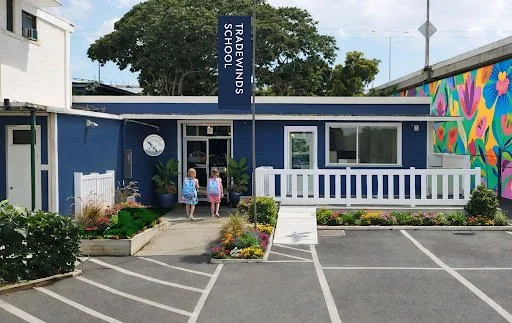
Tradewinds campus in Honolulu’s Kaimukī neighborhood (building is real, landscaping and kids are AI generated—soon to be real)
Tradewinds is a new K–8 school opening in Honolulu this week, built for gifted learners, a group long underserved by Hawaiʻi's public and private schools. Gifted children are an ideal first application for this approach because they need real differentiation, fast pivots, and deep inquiry, and because they suffer acutely when asked to wait for the middle of the class to catch up. The broader opportunity reaches well beyond gifted education, though. I believe every school should eventually be able to build or adapt technology that reflects its own pedagogy, and Tradewinds is meant to be one early proof point that this is possible.
We are building the school, the curriculum, and the software together, because they cannot honestly be separated. If software shapes the learning experience, then it has to be designed with the same care as the classroom.
A crucial boundary comes with that commitment. We are targeting no more than 20% screen time, with roughly 80% of the day off-screen: teacher-led, social, physical, hands-on, outdoors, and rooted in real relationships. The digital time has to earn its place in that budget. When a short AI conversation makes the next hands-on activity richer, we use it. When the useful thinking is done, the laptop closes.
The software we are building is called Rabbithole, and it is open source. A few principles guide it. The AI asks questions more often than it gives answers. Teachers shape the prompts and the learning environment. Assessment emerges from dialogue rather than only from tests. A student's interests become entry points into serious work. Parents and teachers can inspect exactly how the system behaves, and the school controls its own data and its own tools.
Picture a teacher planning a lesson where students build suspension bridges from simple materials. Beforehand, Rabbithole pre-briefs each student: what makes a bridge strong, where they expect tension and compression to show up, which failure mode they are curious to test. Then the class builds, and that experience stays physical, social, and teacher-led. Afterward, Rabbithole debriefs each student on what surprised them, where their bridge failed, and what they would change next time, and it generates a discussion guide for the teacher built from the best questions and the most common misconceptions in the room. A generic chatbot would simply tell a student why bridges fail. A teacher-designed AI helps that student arrive with sharper questions, notice more while building, and reflect more carefully afterward.
The same logic extends to homework, which we are reimagining as Quests: multi-week, at-home inquiries loosely tied to a unit theme, sometimes proposed by a teacher and sometimes pitched by a scholar and approved by one. Rabbithole's role in a Quest stays bounded and purposeful. It helps a student clarify a question worth pursuing, nudges them toward observing, reading, making, or interviewing in the real world, keeps a short record of what they tried, and produces a parent-facing prompt so the inquiry comes back to the dinner table. A parent should be able to see that this was productive time rather than wondering what the AI did with their child for 45 minutes.
WHY OPEN SOURCE MATTERS, AND HOW TO JOIN
Rabbithole is a nonprofit project, and we plan to make the code freely available for schools to use and modify because the infrastructure of learning should not be locked inside a private company. Open source lets schools control their own data, modify functionality to match their values, and inspect our AI’s system prompts directly. We have gone out of our way to make those prompts readable rather than hiding them as technical artifacts. Open source also lets a community of educators to collectively improve Rabbithole, or spin off their own versions.
We are currently looking for partners to test Rabbithole in their own classrooms. You can request an invite to Rabbithole or jump the line by registering for our free teacher workshop on September 3, 2026; bring a lesson or activity you have been wanting to deepen.
If you want to try deploying and modifying Rabbithole’s code yourself, point your coding agent at https://github.com/rabbithole-school/rabbithole and ask it to set up a deployment.
If you are an administrator, the most useful thing you can do is ask where your school's pedagogy is currently being outsourced, and which parts of your digital environment ought to be owned, inspected, and shaped by the school itself. You can reach me anytime at andy@tradewinds.school.
THE QUESTION WORTH ASKING
Progressive education means taking children seriously, honoring inquiry, trusting teachers, and designing environments where experience turns into understanding. If we believe all of that, we cannot keep leaving the digital layer of school to vendors by default.
Schools already use technology, so the question is no longer whether they will. The question is whether that technology reflects the pedagogy they actually believe in. The next generation of educational software should be built with teachers, inspected by them, revised by them, and shaped around the children they know by name.
That is the work we are trying to begin at Tradewinds, and we would be glad for your company in it.
—
Get in touch:
We are hosting a free Rabbithole for Teachers event in person in Honolulu on Thu, Sep 3. Spaces is limited, please RSVP
For school administrators or educational technologists who would like to connect about getting a Rabbithole deployment started at your school, email andy@tradewinds.school
ABOUT THE CONTRIBUTOR:

Andy Szybalski is a product designer and engineer with decades of experience building useful and delightful experiences spanning the real world and the digital world. He led product design for Google Street View and co-founded Uber Eats. Andy went on to co-found Cove, an AI startup whose team joined Microsoft in 2026. He and his wife, Dr. Heidi Meck, a clinical psychologist, co-founded Tradewinds School after seeing their gifted child understimulated in one-size-fits-all classrooms.
Andy holds a BS and MS from Stanford in Computer Science and decades of experience and brings that blend of technical depth and design sensibility to how Tradewinds shapes its teaching and its tools. He sees Tradewinds as the hardest and most important design problem he's ever worked on.

