
By Luke Steller
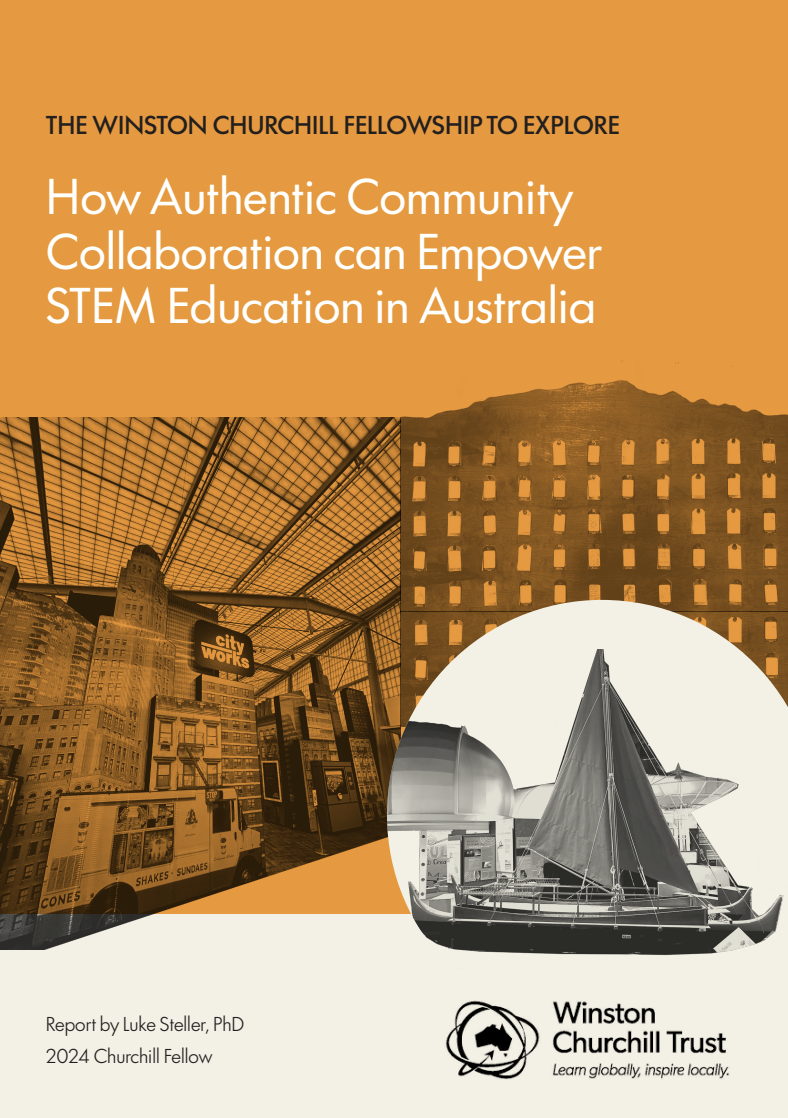
In our previous post, Dr. Luke Steller explored how mission-aligned partnerships—like Hanahau‘oli School’s collaboration with the Mānoa Heritage Center—can transform STEM learning. But how does a school cultivate a staff and student body that is ready for such deep applied work?
The answer lies in the intentional design of the school itself. In this second excerpt from his Winston Churchill Fellowship report, “How Authentic Community Collaboration can Empower STEM Education in Australia”, Dr. Steller shifts his focus to the Hanahau‘oli School Professional Development Center (PDC). He examines our "Professional Development School" partnership with the University of Hawaiʻi at Mānoa College of Education and reflects on what happens when a school commits to professional learning, reflection, and a collective responsibility to growth and improvement. We also invite you to consider joining us for an Immersive School-day Visit like the one Dr. Steller experienced, or our long-term Scholars and Teachers in Residence program, to add your perspectives to our ongoing conversations as we seek to grow as a place of learning, for both children and educators alike.
The following is an excerpt from Dr. Luke Steller’s report, “The Winston Churchill Fellowship to Explore How Authentic Community Collaboration can Empower STEM Education in Australia”.
Background and context
Case study 1 described the Hanahau‘oli School's history, philosophy, traditions and the foundations of its progressive approach. That earlier section focused on mission alignment, project-based learning and community partnerships as they relate to students' experiences. In this case study, the emphasis shifts toward how Hanahau’oli has intentionally built a Professional Development Center (PDC) and a school-university partnership that positions the school as a living laboratory for teachers.
The PDC is central to the delivery of Hanahau‘oli School. Its mission is to build on Hanahau’oli's progressive education tradition to support the development of school communities that promote a better future society for today's children, specialising in progressive philosophy, social justice, school culture, interdisciplinary and inquiry-based teaching and learning. In 2018, Hanahau’oli and the University of Hawaiʻi College of Education formalised an agreement creating a Professional Development School partnership, with Dr. Amber Strong Makaiau appointed to serve as the dedicated bridge between the university and Hanahau’oli as Director of the PDC.
This arrangement is particularly relevant to my Fellowship because it provides a clear example of how one school can meaningfully share its practice without losing focus on its students or overextending its staff. Hanahau’oli's approach is to invest deeply in a single site, align closely with a university partner, and open the campus so teachers and schools across Hawaiʻi and beyond can learn from real practice in real time.
Activities, observations, and lessons learned
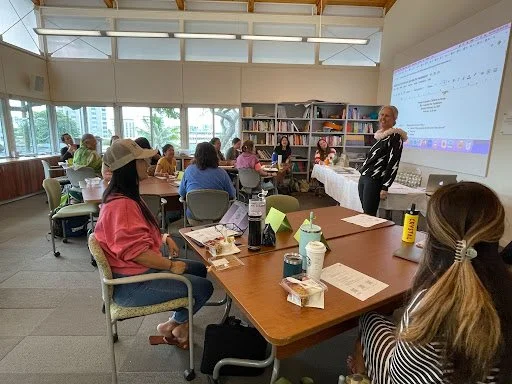
My visit began with an orientation from Amber in the PDC. She explained her dual position as a University of Hawaiʻi academic whose time is partially funded by Hanahau’oli, enabling her to act as a full-time bridge between the school and the College of Education. She described the PDC as a place where teachers, pre-service teachers and researchers can observe progressive education in action and then unpack what they have seen through structured professional learning.
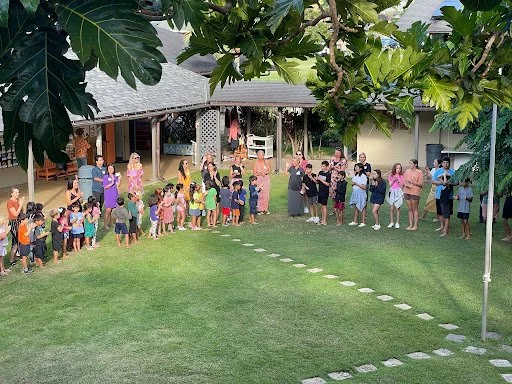
After this briefing, I was encouraged to move freely around the school. Unlike many sites where visitors are escorted or shielded from everyday practice, Hanahau‘oli invited me to wander, step into classrooms, speak with teachers and students, and observe learning as it unfolded. Over the day I visited multiple classrooms across different ages, watched morning circles and community routines, and saw teachers responding to students and each other in real time.
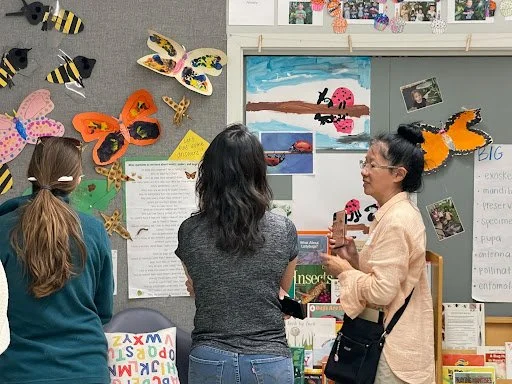
The school deliberately structures its classrooms to support this openness. Many rooms have two teachers co-delivering, meaning one can maintain the flow of learning while the other speaks with visitors. This model made the pedagogy exceptionally transparent. Instead of watching a polished demonstration, I saw authentic classroom practice accompanied by real-time explanations from those teaching.
Students appeared very comfortable with the presence of unfamiliar adults. Several initiated conversations, explained their classroom projects and asked about my visit. Teachers later told me this confidence is a natural result of the open-campus culture: visitors are a normal part of school life, so children learn to articulate their thinking and engage with adults beyond their immediate teacher.
I was also interested in how staff viewed this level of visibility. In many systems, unexpected visitors are seen as interruptions or added pressure. The teachers I spoke with framed it quite differently. They acknowledged that visitors meant they were always alert and attentive, but they described this as a point of pride rather than a burden. Being part of a school that hosts educators from Hawaiʻi, the mainland United States and internationally created a sense of excitement. It motivated them to maintain integrity in their practice and reinforced that what they were doing was valued beyond their own classroom.
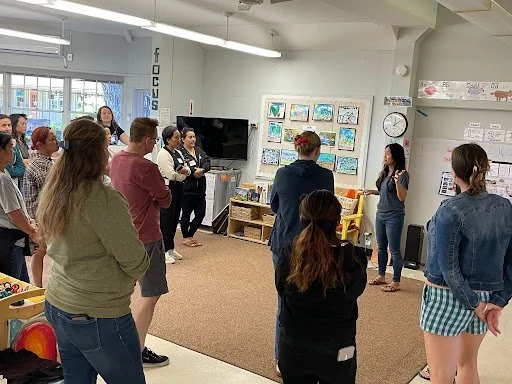
At Hanahau‘oli, professional learning is embedded in the everyday life of the school and actively involves all internal staff. Teachers engage through shared planning, co-teaching, observing colleagues and ongoing reflective dialogue grounded in classroom practice. School leaders participate directly in professional learning alongside teachers, reinforcing that continuous development is a collective responsibility. Administrative and support staff are also involved in training and learning processes, contributing to a shared understanding of the school's philosophy and practices. This whole-school approach ensures professional development is coherent, sustained and embedded across all levels of the organisation.
The university partnership strengthens this work. Under the agreement with the College of Education, the PDC offers courses that can count toward both Department of Education professional development credits and university credit. This gives teachers clear pathways for advancement while embedding Hanahau‘oli's work within the broader ecosystem of teacher education and research. Amber's dedicated role allows her to curate resources, mentor teachers and coordinate school visits in a way that would be difficult for a classroom teacher or deputy principal to sustain on top of other responsibilities.
Across conversations with Amber and teachers, another theme emerged: Hanahau‘oli has intentionally chosen depth over breadth. Rather than trying to influence large numbers of schools through small-scale outreach, they have concentrated resources on doing something exceptional in one place and inviting others to come and learn. The visitor model, the school-university partnership and the structured PDC programs all flow from this strategy. It is a deliberate decision to focus on quality rather than rapid spread.
Lessons learned
Lesson 1: A living laboratory for professional learning
Hanahau‘oli demonstrates the power of treating a school as a living laboratory. Instead of separating professional development from classroom experience, the PDC's approach positions the school itself as the learning site. Visiting teachers can observe authentic lessons, see how thematic units unfold, watch democratic routines in action and discuss the reasoning behind what they are seeing with the teachers involved.
My ability to move freely, enter classrooms at will and speak with teachers during lessons made the learning environment unusually transparent. The co-teaching model allowed one teacher to continue teaching while the other explained decisions, highlighted key moves or unpacked the underlying philosophy. This supported a depth of professional reflection that would be difficult to achieve in traditional PD settings.
This approach also benefits students, who become accustomed to articulating their thinking with adults and gain confidence through authentic interactions. For my work on community-led STEM and educator networks, Hanahau‘oli showed how a single school can become a sustained site of professional inquiry, not merely a place where programs are delivered.
Lesson 2: Deep partnership as infrastructure for professional development
A second lesson is the importance of a structured school-university partnership. The PDC is not simply a school-led series of workshops; it is embedded within a formal agreement with the University of Hawaiʻi's College of Education. This allows the PDC to offer system-recognised credits, engage pre-service teachers, host research projects, and maintain continuity across years.
Amber's dedicated connector role is crucial. Because her position is jointly supported by the school and the university, she has the time and mandate to design PD, mentor teachers, coordinate observations and maintain the partnership. In many Australian contexts, this kind of bridging work falls informally to a staff member who is already overloaded. Hanahau’oli shows what becomes possible when this work is properly resourced.
The school's ability to host visitors safely and productively also relies on having a dedicated role responsible for professional learning and engagement. Amber oversees pre-screening and induction processes that ensure visitors understand expectations around safety, conduct, and interaction with students before entering classrooms. She also supports visitors to integrate what they observe through guided walkthroughs and structured debriefs, helping translate classroom practice into meaningful professional learning. This role safeguards the school community while ensuring visits are purposeful, reflective, and aligned with the school's approach to teaching and learning.
Lesson 3: Quality over spread - one focused site with open doors
The third lesson is Hanahau‘oli's deliberate decision to focus deeply on a single, highly resourced demonstration site rather than attempting to scale its work prematurely across multiple schools. Their influence does not come from operating in many locations or running short-term programs elsewhere, but from being a place that educators actively seek out because the quality of practice is consistently high and visible. By concentrating time, expertise, and resources into one campus, the school has been able to refine its approach over many years, build strong internal coherence, and establish robust partnerships, particularly with the university. This depth allows visitors to see progressive education enacted with integrity across curriculum, pedagogy, school culture, and professional learning, rather than encountering isolated examples.
This approach suggests a different way of thinking about scale in education systems. Rather than equating impact with numerical reach or rapid replication, Hanahau’oli demonstrates the value of concentrating excellence in one place and creating intentional mechanisms for others to engage with that site through observation, dialogue, and reflection. In this model, influence spreads through immersion and adaptation rather than duplication, allowing visiting educators to translate what they see into their own contexts while preserving the depth and coherence of the original practice.
Implications for an Australian context
Hanahau‘oli's approach has several implications for Australian schools and educator networks, particularly in the Northern Territory and other regional settings.
First, the living laboratory model suggests the value of identifying one or two demonstration schools in a region and investing in them as places where teachers can observe authentic practice. In the NT this could help overcome the challenge of fragmented PD by giving teachers a concrete site where they can see inquiry, community engagement or STEM integration enacted in real classrooms.
Second, the school-university partnership highlights the need for a dedicated connector role. Often responsibilities for partnership-building and professional learning are distributed informally across multiple roles. A structured partnership, potentially involving a university or industry partner, could provide more stability and focus. A single staff member with responsibility for connecting schools, coordinating visits, and curating professional learning could significantly strengthen regional networks.
Finally, the open visitor culture raises valuable questions about transparency and shared practice. While Australian schools may not replicate Hanahau’oli's conditions directly, elements such as learning walks, open classrooms for colleagues or structured community observations could help build trust and professional dialogue. Even virtual observation of a demonstration site could support regional and remote schools.
ABOUT THE CONTRIBUTOR:
This post was curated by the Hanahau'oli School PDC. The introduction was co-authored with Gemini, reflecting our ongoing exploration of how AI can support the sharing of progressive educational narratives.
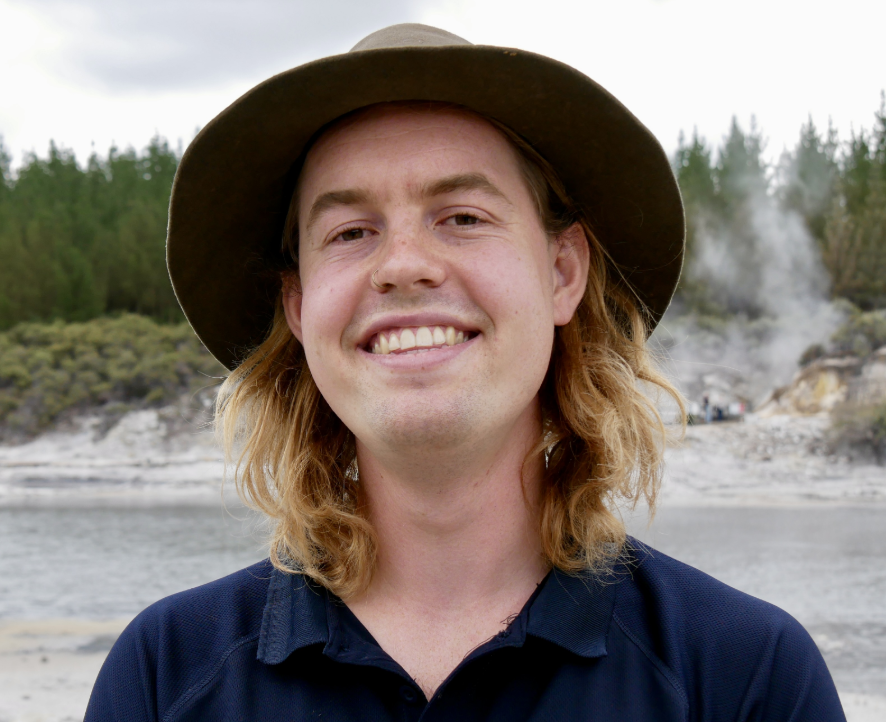
Luke Steller is an education and community engagement specialist focused on building networks that support and amplify under-represented voices in education. Over the past eight years, he has led projects that bring people together to explore how science education can be used as a tool for community empowerment
His work includes building partnerships between schools and First Nations Knowledge Holders to support On-Country learning and developing programs that use education to support communities transitioning from coal-based economies towards sustainable futures. He also created The STEAM Room, a national science comedy show featuring Dr Karl, which trained researchers to share their work through storytelling and performance.
Now based in Mparntwe, Alice Springs, Luke is the Northern Territory Regional Leader for Questacon, the Australian Government’s National Science and Technology Centre, where he builds networks and resources to support teachers and communities across the NT.
He holds a PhD in geology from the University of New South Wales, where his research explored the environmental setting of the Earth’s oldest fossils in the Pilbara on Nyamal Country in Western Australia.

