
By Kate Werner with a foreword and afterword by Dr. Clare Baek
The Navigating AI in Education Think Tank took place over three days during the summer of 2026. On the last day, something magical happened. All the moments leading up to that day—identifying our own values, perspectives, and experiences with AI; understanding the tensions surrounding its use; hearing different perspectives; engaging in healthy push and pull; and collectively making sense of what AI is and is not—came together. As a recipient of a Hanahau‘oli School Professional Development Center Scholarship, Kate Werner thoughtfully engaged in the workshop and then shared her takeaways and reflections with us to extend to others who may be seeking to grow in their own thinking about AI and education. She beautifully describes her experience below. – Dr. Clare Baek
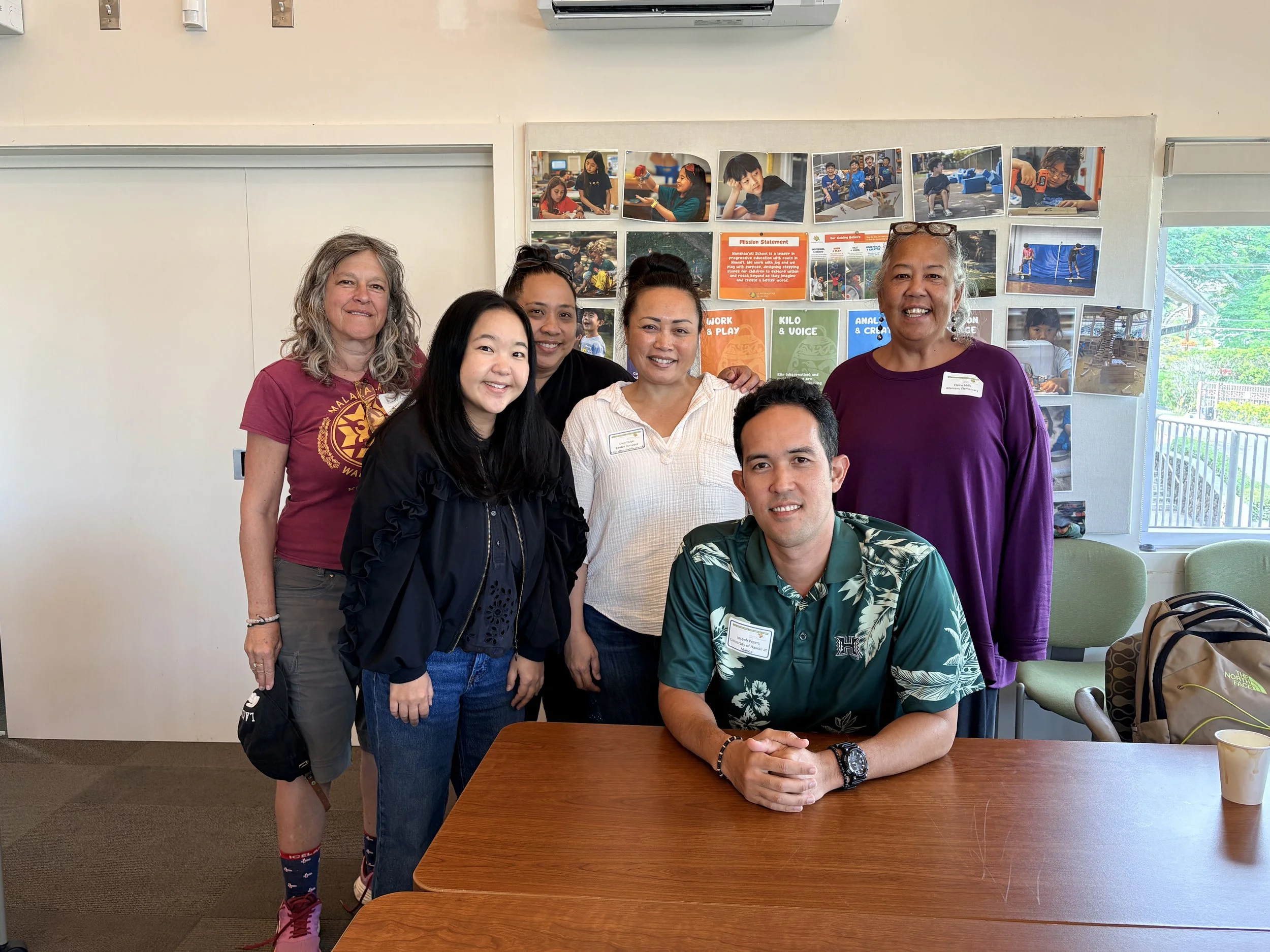
I have been teaching middle school English Language Arts for a dozen years, and prior to that I was teaching at a local high school, all on O‘ahu. I have always been drawn to progressive education philosophy and pedagogy, especially after learning about and applying Philosophy for Children (P4C) to my own teaching practice. I am a very hands-on teacher, using paper and pencil almost exclusively, along with talking pieces like the P4C community ball, all in the service of building community and inquiry-based instruction. I have fallen in love with slowing things down and digging below the surface, and I’ve had the luxury of teaching in classroom settings where there hasn’t been the pressure to cover vast material or accelerate through books to make sure we “get where we need to be.” This has allowed me to follow the students’ leads and really take time to explore deeply the ideas that they find intriguing. The result of this “rubbing of brains” is people really attending to one another’s thoughts, deeply considering other perspectives, and often finding a change of opinion or at least a healthy respect for the other side’s thinking.
During the COVID virtual teaching years, I was worried that without our P4C community ball, we would not develop the relationships and good thinking that was a huge piece of my curriculum. But I was wrong. We still “passed the ball” by calling on one another as hands were raised or doing an “around the room,” making sure we recognized each person and invited them to contribute as we often did when in person. Students reliably came to online class, would stay on after class ended, and our conversations and sharing would continue. If anything, those classes were more intensely bonded.
For the most part, I also decided to keep much of the teaching and learning in my classroom “off screens” in an effort to support a more measured pace and unhurried school experience. In fact, prior to the AI workshops that I attended in the past year, I rarely used Google Classroom, only for students to work on writing either individually, in pairs, or in small groups. That way, I could follow along as the teacher and make suggestions as they worked, all the while keeping the integrity of my classroom’s intentionally relaxed and calm rhythm.
With all that said, in this past year, I sought out two professional development opportunities through the Hanahau‘oli School Professional Development Center to better understand Artificial Intelligence and its growing impacts on education. In Fall 2026, I attended a workshop called Beyond the Bot: Cultivating Critical Writers in the AI Era. This workshop, led by Robin Dazzeo, was my introduction to AI. Before this, all I really knew about AI was that students were using it to create essays and projects, and were doing it quickly, mindlessly and without thought or care for its impacts. I remember seeing a poem by a 4th grader that I was tutoring; it was pretty good but vacuous and I asked her, “Did you write this?” I was a bit impressed because it seemed beyond her abilities and she told me “AI did it.” It was like a punch in the gut coming from a student at a screen-free Waldorf school, and I was completely unprepared. So when I went into this first workshop, I was a bit anti-AI and I really had little idea what AI even was. The workshop facilitator admitted that like the rest of us, she was experimenting with the new technologies and had some ideas of what was working well, but was really just beginning to engage with AI with her college level students. She focused the workshop on how she used AI for herself, in her planning, and in curriculum development. I was introduced to Claude, her AI tool of choice, and I began to have a sense of the power of the tool and how at least I could use it in a positive manner.
This is why I decided to join the 3-day AI Think Tank, Navigating AI in Education for Teaching, Learning, and Strategic Planning in June 2026. Facilitated by the University of Hawai‘i’s Dr. Clare Baek, we spent two days reflecting and dialoguing about our own and each other’s thinking around AI. Lots of information, exercises and discussions ensued. On Day 3, one participant humorously reflected, “We are really all lost together. There is no coherence.” Yes, and would there be guidance from the HIDOE, some wondered. AI felt like a wild beast with a fragile harness that was controlling us. In this mire of uncertainty, I admitted that I really felt like I knew nothing more than when I started.
But then I had an epiphany. I found myself recognizing that we really need to accept AI is the new norm. I resolved to maintain my focus on slowing things down with students and to teach the process of using AI by focusing on quality over quantity. With the help of Dr. Baek and my fellow Think Tank participants, I was able to think strategically about how to accomplish this. For instance, instead of having students use AI to gather lots of facts and information about a topic, I plan to have them take a small piece of information from AI and take them through the process of effectively using AI with a values-based lens. More specifically, I decided I want students to understand how to engineer minimal and clear prompts, to fact- and source-check, and then to know when to take it offline and make sure the voice that is being heard is a human one, the student’s own voice.
As a Think Tank, we spent the whole third day of the workshop on the idea of what a slow framework to AI would look like. We spoke of values–the environmental impact, the social impact and the preservation of critical thinking. These values all would lend themselves to a “slow” AI role, where time is spent with a pencil or keyboard generating a very accurate, carefully worded prompt in order to elicit the specific piece of information that is wanted. By doing this, an educator’s essential role shifts to teaching students and ourselves to not over-rely on AI, to not do countless silly prompts that are wasteful, to not try and “prompt into perfection”, and to know when to go offline with the information; ultimately, the goal is to use our thinking to create, and AI’s efficiency and wide-spread reach to gather information, to organize or to create a product that we then review and use our human minds and hearts to improve, alter and design.
At the Think Tank, we collaborated as a group, without AI, to create an AI framework that students and teachers could use. We persevered through many iterations and rather than use AI to do the work, we generated all the wording and ideas ourselves. Laughing, we told our young presenter to put in her own periods rather than leaving that to the work of AI. The metaphor of the 3 R’s– Reduce, Reuse and Recycle — comes to mind and since I left the workshop, I am implementing this style into my own use of AI. I have been purposeful about topics I present to Claude (now my chosen AI) and ones I use “old-fashioned Google” to research to Reduce my use of the technology, as Claude is so much more user-friendly but it’s also energy-intensive and hard on the environment. I have been returning to previous chats to see what Claude said about the same topic rather than just asking again, as well as organizing my chats so I can find information quickly in an effort to Reuse data and further reduce my resource consumption.
I want to share a bit more about my process as I am writing this. So far, this is all my own thinking and writing, but I just got stuck on recycling as it applies to AI, so I asked Claude about this concept in general and how we might look at recycling and AI. From AI: “I’d say recycling means transforming the output into something new through your own labor. Just like you break down a plastic bottle and remake it into something different — you take AI output, break it apart (keep a phrase here, an idea there, discard the rest) and remake it into your own original thing. The AI output becomes feedstock, not the final product. Your thinking and craft do the transforming.” Also from Claude, this time paraphrased, is that a 4th R could be to Refuse–to know when the tool simply isn’t the right one and to refuse to pick it up. Instead, I pick up a dictionary, call a friend or just keep working on the final draft myself.
In fact, after I did this very work on this very piece of writing, I ran it through AI with a specific prompt asking for only 2 improvements (Reduce). For one, AI asked, how would you bring P4C back into this with the students–or rather, what is P4C like with “AI at the table”? I like this! Secondly, Claude suggested taking a beat to reflect on how I am modeling AI use right now. I like this, too! Here, I noticed wanting to ask AI to do the work, to transform my work by adding in these two ideas, but I resisted. I took the “feedstock,” I paused, stretched and persevered, and it felt good to add in the ideas in my own way. I, as the human, often do garner a thought or a new idea from using AI, and I can work that into my own thoughts and hopefully produce an even better product, or Recycle. This is key: helping students do the hard work of making the iterations themselves as that’s where the learning lives. This is hard work and will require coaching and scaffolding and serious direction.
So, how would I bring P4C back into the equation? I can see getting stuck in a discussion, and only at that point, the class designs a prompt for AI- a perfect opportunity for teaching the prompting process whole-class. Then we “pass AI the ball,” inviting AI’s long reach to contribute. Then we ponder what we’ve been given. We pass the ball around and continue our inquiry with new information. We take the time to digest it and decide if and how we want to include it in our discussion and in our creative process and product. The experience of writing this essay with the intentional use of Claude, and the choices I made along the way about when to use AI and when not to is exactly what I will bring to my students, supporting using it as a tool, not as our master or our savior.
Afterword
We only arrived at these insights because we were willing to slow down, sit with uncertainty, listen carefully to one another, and resist the urge to rush toward the desired outcomes we wanted. The participants and I developed our own AI framework, the Slow AI Method.
While this framework is not a solution that provides all the answers, it helps solidify our positionality and approach to AI. It is also an approach that can be applied both in our teaching and in our own use of AI. Since the Think Tank, I have been using this framework in my own practice and have found that my relationship with AI has become clearer and more comfortable. The framework helps me navigate tensions such as efficiency versus environmental impact and innovativeness versus critical thinking.
Most importantly, we found in one another, a community of colleagues we can turn to, learn from, and grow with as we continue to navigate AI in education. – Dr. Clare Baek
ABOUT THE CONTRIBUTORS:

Kate Werner has been teaching secondary English Language Arts for over twenty years, most recently at Honokaʻa High & Intermediate School on the Big Island of Hawaiʻi. She is a practitioner of Philosophy for Children and brings a culturally responsive, inquiry-based approach to her classroom, centering Hawaiian and local community knowledge in her curriculum design. She attended the June 2026 AI Think Tank at Hanahauʻoli School on a full scholarship and a prior workshop, Beyond the Bot: Cultivating Critical Writers in the Era of AI, and is interested in participating in research and application of generative AI with her high school classes — particularly in developing frameworks that help students engage with AI tools deliberately and critically rather than reflexively.
Dr. Clare Baek is an Assistant Professor at the Learning Design and Technology (LTEC) Department in the University of Hawaiʻi at Mānoa. She holds a Ph.D. in Urban Education Policy (Education) from the University of Southern California. Her work focuses on investigating the societal and individual factors that shape students’ use and perceptions of generative AI. She has led discussions on the current and evolving role of AI in education and intuitional policy through invited talks and lectures at national and international institutions.
At the University of Hawaiʻi at Mānoa, she teaches a graduate course on AI for Human Learning, where she facilitates discussions on theoretical and practical applications of AI in educational contexts, and serves on an LTEC department subcommittee focused on systemically integrating AI into the program. In addition to her work in AI in education, she has expertise in designing computational thinking curricula integrated with community knowledge through partnerships with teachers across school districts. Previously, she worked as a mentor teacher and computer science department chair at a K-12 STEM school serving students with social and emotional disabilities.

