
By Dr. Christoph Kühberger
In 2023, visiting scholar Dr. Christoph Kühberger immersed himself in a variety of educational settings across O‘ahu, including Hanahau‘oli School. The blog to follow provides a window into the insights he had about how educators in Hawai‘i teach critical historical concepts like “change, continuity and context,” “perspective,” and the use of “historical sources and evidence” (see The College, Career and Civic Life Framework for Social Studies State Standards) in Hawaiian history. His unique observations, awareness, and perceptions about sometimes taken for granted approaches to teaching about Hawaiian history and culture today offer progressive educators important food for thought. He provides us all with tools for examining how static historical representations of people can shape the way students make sense of their world today and see the future.
This essay had been taking shape in my mind for a long time before I finally put it into words. It grew out of observations I made during my stay in Honolulu from spring through summer 2023. As a visiting scholar at the College of Education at the University of Hawaiʻi at Mānoa, I spent time conducting research in libraries, museums, and archives, while also having the opportunity to visit a wide range of schools across Oʻahu. My primary interest was understanding how the ʻōiwi wale nō era[1] is taught and represented across different educational and cultural institutions. The term refers to the long period during which Kānaka ʻŌiwi/Hawaiians lived in cultural exchange with other peoples of Oceania, prior to sustained contact with the wider world.
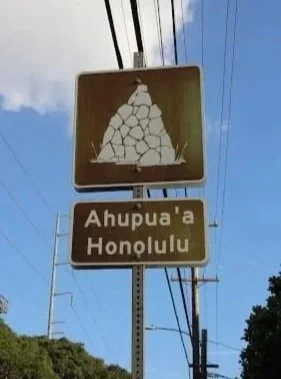
I, therefore, had the opportunity to visit a wide range of educational sites across Hawaiʻi that engage with the archipelago’s past. One thing quickly became apparent: the ahupuaʻa serves as a central point of reference and remains a constant in how Hawaiian history is interpreted and taught. An ahupuaʻa is typically defined as a traditional Hawaiian land division that organized society, agriculture, water management, and resource use from the mountains to the ocean. While seemingly straightforward, it raises important questions about how the Hawaiian past is framed, categorized, and represented in educational contexts.
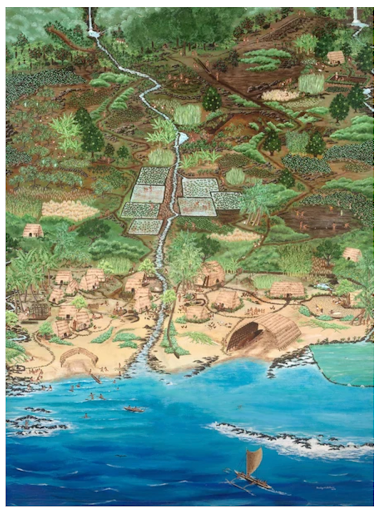
Today the ahupuaʻa is not only a geographical reference point or a territorial unit marked by signs across the islands, but it has also become an ideal lens through which to understand Ancient Hawaiʻi. This is reflected not only in Marilyn Kahalewai’s painting of an ahupuaʻa – widely reproduced also as a famous poster – that can be found in libraries, schools, museums, and other educational spaces throughout Hawaiʻi – but also in contemporary discussions about food sovereignty and cultural efforts to reconnect Kānaka ʻŌiwi with ʻāina /land. The Hawaiian word ʻāina serves here as an important link. Derived from ʻai (“to eat”), it is often understood as “that which feeds us.”[2] As a result, the ahupuaʻa has become a focal point for shaping and communicating diverse narratives about Hawaiʻi’s past, many of them closely tied to contemporary issues.
These narratives can be critical in nature – for example, when addressing the illegal overthrow of the Hawaiian Kingdom – or they can focus on the revitalization of socio-ecological and socio-economic practices rooted in the past. In this way, the ahupuaʻa fulfills an important function on multiple levels. It is therefore not surprising that many teachers I spoke with on Oʻahu described the ahupuaʻa as a major component of their instruction on Ancient Hawaiʻi. In many schools, the topic is revisited repeatedly across different grade levels, with students engaging in increasingly detailed explorations of its various dimensions. Field trips are also common, allowing learners to investigate specific aspects of the ahupuaʻa firsthand and in greater depth, for example in an ʻāina based learning.
What stands out to me as a history educator is that, in this way, Ancient Hawaiʻi is too often reduced to a set of ideas and images associated with the ahupuaʻa, which has increasingly become a pars pro toto for the entirety of Ancient Hawaiʻi. Educators and institutions frequently seem satisfied with a single key element drawn from the later ʻōiwi wale nō era, treating it as if it can explain the whole. The result is the creation of historical imaginaries that freeze linear, genealogical, and cyclical understandings of time alike. Change, development, and transformation over time become difficult to perceive. The same tendency can be observed on another level as well.
Terms such as “Old Hawaiʻi,” “Early Hawaiʻi,” “Ancient Hawaiʻi,” or “The People of Old” often transform temporal dynamics into static conditions by imagining the ʻōiwi wale nō era as a single, monolithic block. In doing so, this long period of several hundred years is presented as a frozen moment in time rather than as a history marked by change, adaptation, and development. Within this framework, it can appear as though little or nothing has changed over the course of generations. Such a perspective is strikingly consistent with nineteenth-century Western ethnological ideas that portrayed Indigenous societies as “without history,” living primarily from one day to the next in pursuit of basic subsistence needs.[3] Beyond ignoring – or even diminishing – the ways Kānaka ʻŌiwi themselves understood, remembered, and related to the past, this perspective typically treats the final segment of the ʻōiwi wale nō era as representative of the entire period. The social, political, and cultural conditions of this later era are then projected backward onto the entire period following the arrival of the first people on the islands. In this sense, one is left following a peculiar ethnological gaze rooted in the height of the Western colonial era, one that essentializes Hawaiian culture and obscures a more differentiated engagement with change in time, whether approached through Hawaiian or Western epistemologies. Change is effectively negated, and in representations such as the ahupuaʻa poster, the course of time is reduced to a static condition. Suddenly, all ancestors seem to inhabit the same village, living in the same way, regardless of when they lived on the islands. This was certainly not the intention behind the poster. Yet it has contributed to the formation of a powerful imaginary about the past, one that continues to shape how Ancient Hawaiʻi is understood and represented today.
No culture ever stands still. Every culture experiences change and development over time. Yet Marilyn Kahalewai’s painting of the ahupuaʻa, which was later reproduced as a poster and supplemented with educational materials by Kamehameha Schools (1978, 1982, 1994),[4] developed its own peculiar dynamic of stasis as an icon of Hawaiian historical culture.[5] As a powerful visual anchor depicting an “idealized Hawaiian valley as it would have looked in the years before foreign influence changed the environment and lifestyle of the Hawaiian people”[6], the image has been far more influential than the informational and educational materials that have accompanied it. Those materials, in fact, do provide a temporal reference by locating the scene “in the time of ʻUmi.”[7] This reference points to ʻUmi-a-Līloa, who, based on attempts to situate him within a Western chronological framework, is generally thought to have lived around the turn of the sixteenth century.[8]
Barry A. Costa-Pierce has argued that the ahupuaʻa became established as a system sometime between 1500 and 1800.[9] This also implies that there was a period before its emergence, during which land use and relationships with the land were organized differently. It is precisely these deeper temporal structures that disappear behind the poster or similar imaginations and often go unnoticed. This becomes particularly evident when examining textbooks and educational materials for children and young people. The arrival of the first people in the islands is certainly addressed. Yet the reconstruction drawings are always similar. They communicate continuity, but also a sense of unchangingness across several hundred years, a representation that is highly questionable.
For Social Studies instruction dealing with Ancient Hawaiʻi, it will be necessary to trace this long duration while also making visible the changes that occurred within it. It is difficult to think about meaningful forms of periodization without a broader educational discourse on how such temporal divisions might be structured and how they could be connected to both Hawaiian genealogical understanding of time and Western linear conception of time. One thing, however, seems clear: the current approach, coupled with the reinforcement of a fundamentally misleading imaginary of Hawaiian political, social, and cultural development, is unsatisfactory. It contributes more to solidifying a distorted imagination of the Hawaiian past than to making visible the complexity of its political, social, and cultural transformations. As a provisional step, I therefore suggest, drawing for example on the work of Davianna Pōmaikaʻi McGregor and Melody Kapilialoha MacKenzie,[10] discussing three phases of the ʻōiwi wale nō era: (a) an Era of Settlement, (b) an Era of Development, and (c) an Era of Expansion. In addition, the cosmological origin of kānaka, and thus Hawaiian creation narratives as an expression of genealogical time and connection to ʻāina, should also be incorporated.
In a blog on progressive education, however, it should not be overlooked that the problem discussed here should also be addressed with students. In the spirit of a critical engagement with the past and with history/moʻolelo, the enormous influence of images on our conceptions of the past should be reflected upon just as critically as the foundations of the knowledge about the past that is conveyed through such images. In doing so, both Western and Hawaiian modes of engaging with and understanding the past should be carefully considered, allowing students to reflect on differing epistemological and cultural approaches to moʻolelo/history.
[1] Cf. Goodyear-Ka'ōpua, Noelani: The seeds we planted. Portraits of a Native Hawaiian Charter School. Minneapolis 2013, 2.
[2] Cf. Pukui, Mary Kawena /Elbers, Samuel H.: Hawaiian Dictionary. Honolulu 1986, 11.
[3] Cf. Fabian, Johannes: Time and the other. How Anthropology makes its Object. New York [1983] 2002,18-21.
[4] Hawaiian Studies Institute Staff: Tha Ahupua’a. Life in Early Hawai’i (3rd Edition). Honolulu 1999.
[5] Historical culture encompasses both academic and popular articulations of history and includes the many ways in which societies make sense of the past. – Cf. Grever, Maria/Adriaansen, Robbert-Jan: Historical Culture. A Concept Revisted. In: Palgrave Handbook of Research in Historical Culture and Education. Hg. v. M. Carratero et al. London 2017, 73-89, 79.
[6] Hawaiian Studies Institute Staff: Tha Ahupua’a. Life in Early Hawai’i. Honolulu 1999, V.
[7] Hawaiian Studies Institute Staff 1999, VI.
[8] Cf. as estimated within a Western chronological framework: Office of Hawaiian Affairs/Research Division: Ke Ali‘i Nui ‘o Kalani‘ōpu’u (Land, Culture, and History Section, Information Sheet) November 2014, 2.
[9] Costa-Pierce, Barry A.: The Ahupua. Aquaculture Ecosystems in Hawaii. In: Ecological Aquaculture. The Evolution of the Blue Revolution. Ed. by Barry A. Costa-Pierce. Maiden. MA 2002, 30-43, 30.
[10] McGregor, Davianna Pōmaika‘i/MacKenzie, Melody Kapilialoha: A Brief Summary of the History of Native Hawaiian Governance in Hawai‘i. Honolulu 2013.
ABOUT THE CONTRIBUTOR:
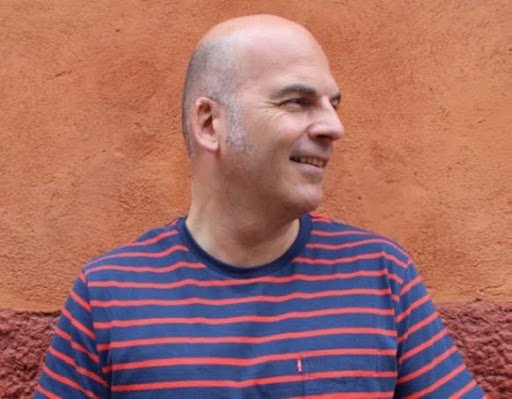
Dr. Christoph Kühberger is a Full Professor of History Education and Civic Education at the Department of History at the University of Salzburg, Austria. His research focuses on history education, historical culture, public history, and the ways children and young people engage with the past. He has conducted extensive research on children’s historical thinking, including studies on the role of toys, material culture, and nonfiction books in shaping young people's understandings of history. In 2023, he was as a Visiting Scholar at the College of Education at the University of Hawaiʻi at Mānoa, where he investigated approaches to teaching about Ancient Hawaiʻi and the role of Indigenous knowledge in history education. His recent work explores the decolonization of historical thinking and the relationship between Hawaiian ways of knowing, moʻolelo, and history education. https://www.christophkuehberger.com/english/

