By Laura R. Peterson
One of the greatest honors of my life has been learning, growing, and teaching at the only public high school on the rural and very Hawaiian Island of Moloka‘i. Located in Ho‘olehua, Moloka‘i High School has a predominantly Native Hawaiian student body, with approximately 76.5% identifying as Native Hawaiian or Pacific Islander. As a non-Native Hawaiian, it has been very special to learn from the Moloka‘i High School community; how Hawaiian cultural values can be used in my work as a special educator who aims to foster a holistic, safe, and supportive learning environment for our entire school community.
My Journey Becoming a Culturally Responsive Progressive Educator
After graduating from San Diego State in my birthplace of California, I ended up on Maui. There I lived with one foot in the local world teaching at a high school, and one foot in a transient world working in the hotel industry and living in a very tourist-oriented community. It was not lost on me that these were two very different realities. Once I moved over to Moloka‘i, the transient tourist-oriented world slipped away, and I was left in a local community and the reality of living a rural lifestyle.
At Moloka‘i High School I have been a special education teacher, a student support resource teacher at the complex level, and then the student services coordinator back at the high school. In each of these roles, my passion has always remained student academic and social-emotional success. Luckily, over the years, there have been many progressive education initiatives implemented to achieve those results: project-based learning, integration of student voice, and social-emotional learning curricula, to name a few. All have shown promise. However, based on my observations, harnessing the power of culture in combination with any of these initiatives has shown to increase the potential of each approach.
For example, at Moloka‘i High School, if something was presented without a cultural component (or even sometimes when it was), the staff and students reacted by asking for a more culturally appropriate version. This led me to believe that incorporating Hawaiian culture into teaching and learning at Moloka‘i High helps to increase the efficacy of evidence-based strategies because it makes them more relevant. Now, in my most recent work creating a cultural-social-emotional disability awareness project, I believe this to be true not only for Moloka‘i students, but for students with Hawaiian roots and indigenous wisdom throughout the state.
Creating a Cultural-Social-Emotional Disability Awareness Project
To plan my project, I used the Nā Hopena A‘o or HĀ (which means breath in Hawaiian) framework. The creators of this cultural-social-emotional structure designed it in a way that is different from any other Department of Education initiatives I had seen in the past. Like other progressive education reforms the outcomes are more complex to measure, and curriculum designed using HĀ can’t be boxed up and sent as a plug-and-play lesson or unit. This is because Nā Hopena A‘o is made up of six values and beliefs in action: Belonging, Responsibility, Excellence, Aloha, Total Well-Being, and Hawai‘i (the first letter of each spells the word BREATH, or HĀ in the Hawaiian language), and they are meant to be used together, not separated out. Each of the components is supported by an ‘Ōlelo No‘eau, or Hawaiian proverb to help demonstrate the meaning.
As a graduate student pursuing a certificate in Disability and Diversity Studies at the University of Hawaiʻi (UH), my project started as a campaign (No Dis, All Ability) to get rid of outdated institutional thinking about disability. I started with graphics that I turned into stickers that utilized ‘Ōlelo No‘eau to spread a more humane and modern way of talking about disability, according to what I was learning at UH. To sum it up very basically, the old model assumes disability:
is something fixed;
“wrong;” and
the responsibility is on the individual with the disability to navigate the world.
The new model sees disability as:
fluid or dynamic;
a source of strength; and
the responsibility is on all of us to ensure that constructs in our society (the way we present learning, public spaces, events) are accessible to everyone.
My initial efforts were okay, but this was just another initiative, separate from everything else in the Department of Education. Feedback from my professor included “Why don’t you align it with Nā Hopena A‘o?” At that point, “HĀ, No Dis, All Ability” was born.
I started by choosing three main ‘Ōlelo No‘eau that could be interpreted to fit the new social model of disability, as “a single saying often speaks to many topics” (Pukui, pg. vii). They were:
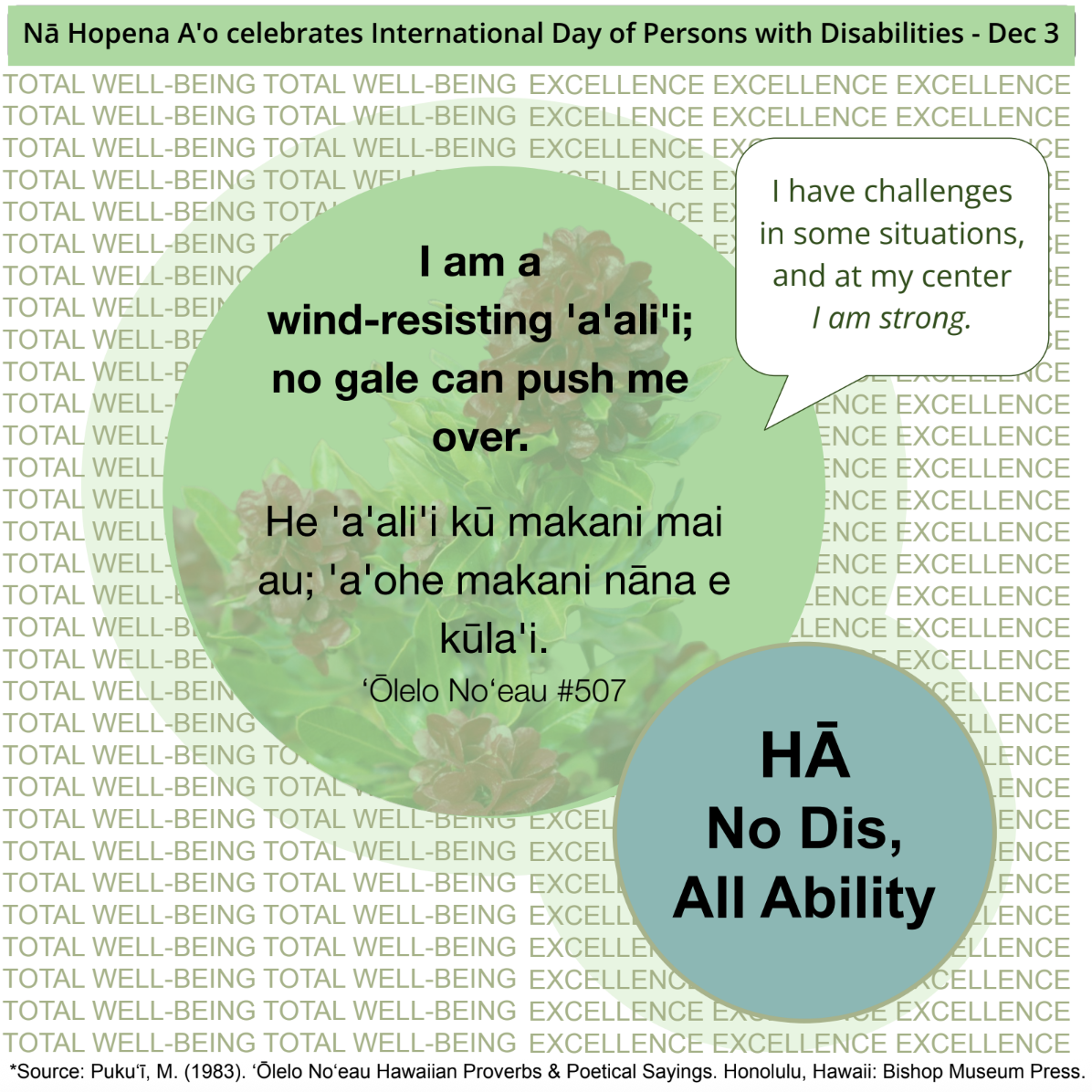
Hawaiian: He ‘a‘ali‘i kū makani mai au; ‘a‘ohe makana nāna e kūla‘i.
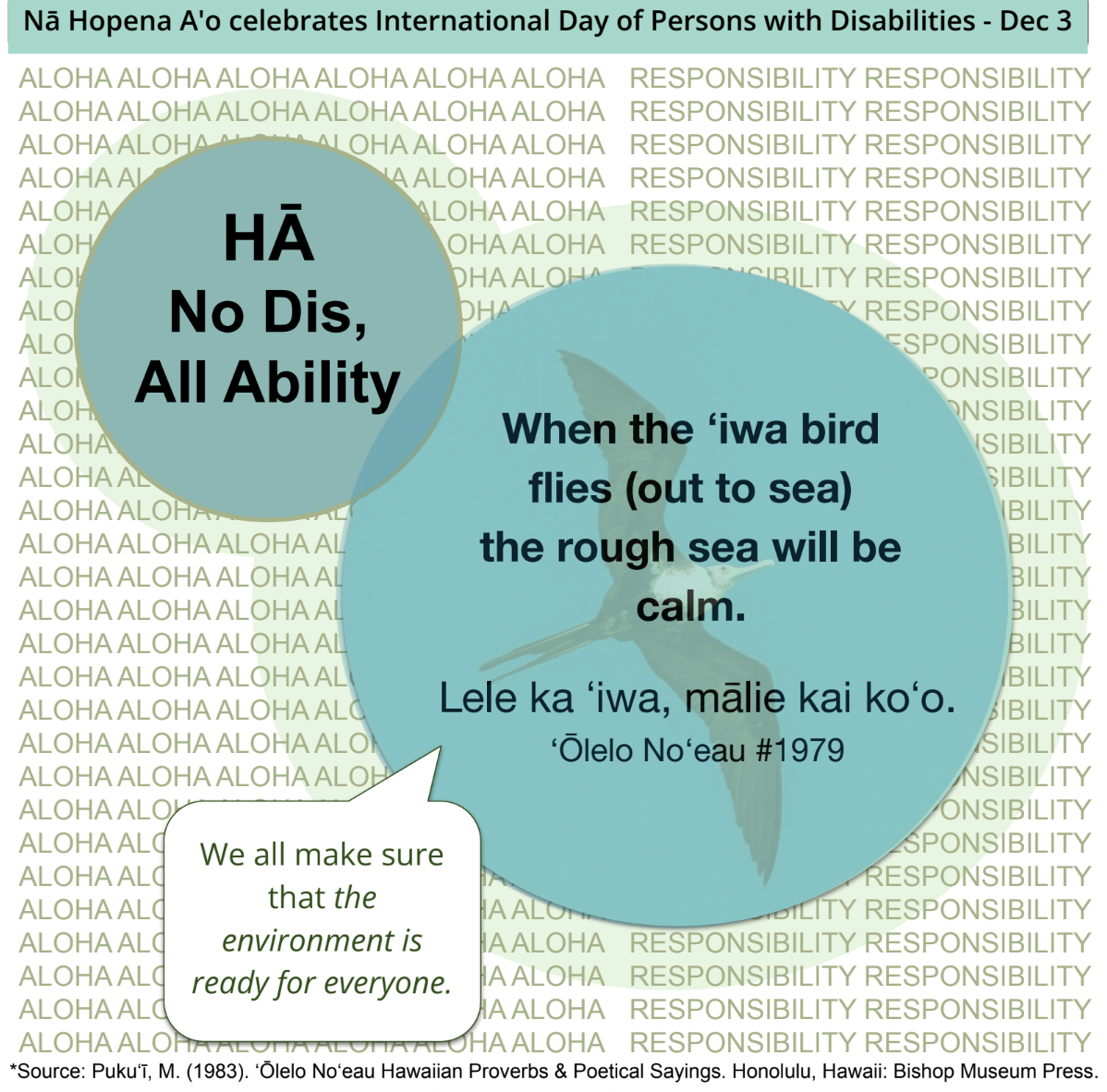
English: I am a wind-resisting ‘a‘ali‘i; no gale can push me over.Hawaiian: Lele ka ‘iwa, mālie kai ko‘o.
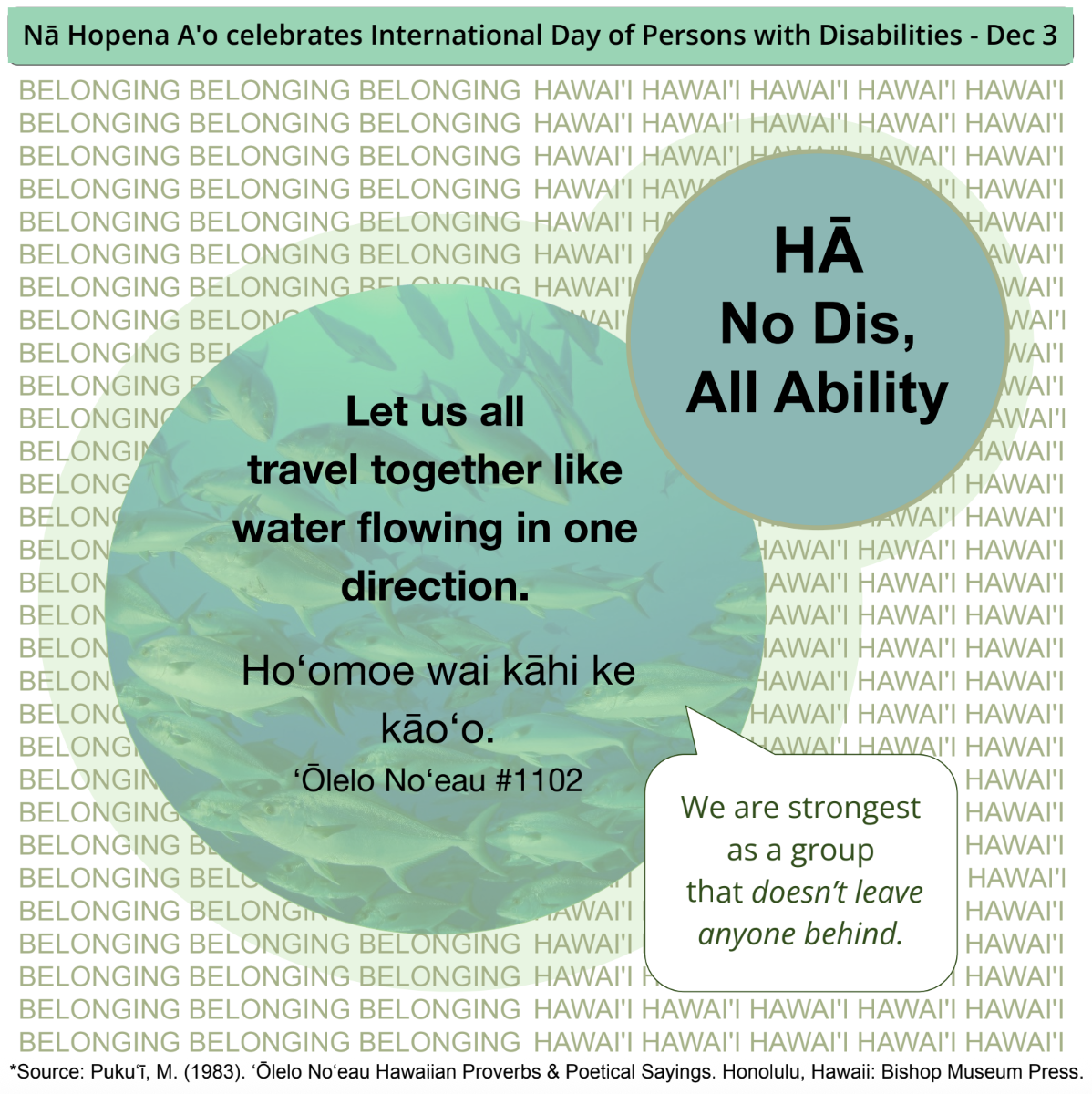
English: When the ‘iwa bird flies (out to sea) the rough sea will be calm.Hawaiian: Ho‘omoe wai kāhe ke kāo‘o.
English: Let us all travel together like water flowing in one direction.
Next, I added an easy read phrase to each ‘Ōlelo No‘eau, to emphasize the message about disability and make the meaning accessible to all readers:
Hawaiian: He ‘a‘ali‘i kū makani mai au; ‘a‘ohe makana nāna e kūla‘i.
English: I am a wind-resisting ‘a‘ali‘i; no gale can push me over.
Easy Read: I have challenges in some situations, and at my center I am strong.Hawaiian: Lele ka ‘iwa, mālie kai ko‘o.
English: When the ‘iwa bird flies (out to sea) the rough sea will be calm.
Easy Read: We all make sure that the environment is ready for everyone.Hawaiian: Ho‘omoe wai kāhe ke kāo‘o.
English: Let us all travel together like water flowing in one direction.
Easy Read: We are strongest as a group that doesn’t leave anyone behind.
Finally, I aligned the six components of Nā Hopena A‘o. It was so shocking to me how perfectly they lined up.
Hawaiian: He ‘a‘ali‘i kū makani mai au; ‘a‘ohe makana nāna e kūla‘i.
English: I am a wind-resisting ‘a‘ali‘i; no gale can push me over.
Easy Read: I have challenges in some situations, and at my center I am strong.
HĀ Components: Total Well Being, ExcellenceHawaiian: Lele ka ‘iwa, mālie kai ko‘o.
English: When the ‘iwa bird flies (out to sea) the rough sea will be calm.
Easy Read: We all make sure that the environment is ready for everyone.
HĀ Components: Aloha, ResponsibilityHawaiian: Ho‘omoe wai kāhe ke kāo‘o.
English: Let us all travel together like water flowing in one direction.
Easy Read: We are strongest as a group that doesn’t leave anyone behind.
HĀ Components: Belonging, Hawai‘i
The graphics for the project also emerged from Nā Hopena A‘o. This included the use of circles and the color green. The three graphics are HĀ, No Dis, All Ability, a collaboration between Nā Hopena A‘o (or HĀ) and disability awareness, and are custom-made for Hawai‘i public schools.
Using the HĀ No Dis, All Ability Project to Promote a More Positive School Culture
At Moloka‘i High School, I chose December 3–the International Day of Persons with Disabilities–to introduce HĀ, No Dis, All Ability and highlight disability awareness. I turned the graphics into posters with the support of a Hawai‘i Social Justice Educator Award. The banner at the top of each poster reads: “Nā Hopena A‘o celebrates International Day of Persons with Disabilities - Dec 3.” I also designed a series of short, light but engaging activities that the students and teachers of Moloka‘i High School could participate in during the week of December 3rd as a part of their Monday through Thursday advisory periods:
Monday: Disability History (Google Form quiz)
Tuesday: Disability Vocabulary (Kahoot game)
Wednesday: International Day of Persons with Disabilities Group Art Activity (Thumbprint mural - supplies distributed to each advisory)
Thursday: Disability Etiquette (Quizlet matching game)
Friday: No advisory, unveiling of Group Art Activity by the front office - Disability Pride flag made up of thumbprints of all students in the school with a key for color symbolism.
Teachers were prepped with packets prior to the first week of December that contained: directions, a copy of the Learning for Justice Social Justice Standards (an anti-bias framework), a set of three small posters, one for each graphic, art supplies, No Dis All Ability stickers, and bookmarks. They were also sent electronic materials with a weekly agenda and links.
Beyond the week that this project launched, the posters were meant to be the lasting installation. They were made to appeal to the young generation, and more importantly my students at Molokai High School. They had short phrases, images from nature, used both Hawaiian and English, and made references to the Nā Hopena A‘o cultural-social-emotional framework that everyone at our school was familiar with. The posters are empowering for those with disabilities and the entire school-community, and they reframe disability according to recent scholarship and research. Now they can be seen in various settings around campus as a permanent part of our school environment.
Becoming Stronger As A Group That Doesn’t Leave Anyone Behind
Prior to working on this project, I noticed that our public school environment sometimes feels dated rather than progressive when it comes to the conversations around disability. Teachers can be awkward and students can be cruel; and this is especially difficult when our goal is to prepare students with disabilities to self-advocate post-high school and in life. What I learned from this project is that the entire school-community benefits from a re-framing of what disability is and what it is not, and the reminder that our community’s success is connected to each individual and is inter-dependent. The more successful those with the most challenges among us are, the more successful we all are as a school.
Since the pilot week for HĀ No Dis, All Ability wrapped up, it has received positive feedback. One was from the Complex Area Superintendent, who said she was interested in complex-area distribution of the posters to all schools for next school year. Another positive feedback was from a State Senator visiting the Molokai Youth Summit, where there was a Disability Awareness booth featuring the activities created for the high school. She took a copy of the poster set and said “this should be statewide,” and if nothing else ever comes of it, this was an important recognition. Finally, I was accepted to present an interactive poster exhibit at the Pacific Rim International Conference on Disability in Honolulu, HI in May 2026. Poster sets will be available for anyone who is interested.
In regards to shifting peoples’ thinking about disability, not only in schools but in society at-large, there is still more work to do. New perspectives on disability require moving from a charity or medical model to a rights-based approach that views disability as a form of human diversity, not a tragedy. Key shifts include fostering personal interaction, promoting equality, listening to lived experiences, and addressing environmental barriers rather than fixing the individual. The HĀ No Dis, All Ability project helped to start the conversation about this at Moloka‘i High School and we are becoming stronger as a group that doesn’t leave anyone behind. Ho‘omoe wai kāhe ke kāo‘o.
Works Cited:
Learning for Justice. (n.d.). Social Justice Standards: A Framework for Anti-bias Education. Southern Poverty Law Center. https://www.learningforjustice.org/frameworks/social-justice-standards
Puku‘ī, M. (1983). ‘Ōlelo No‘eau Hawaiian Proverbs & Poetical Sayings. Honolulu, Hawaii: Bishop Museum Press.
ABOUT THE CONTRIBUTOR:

Laura R. Peterson is an educator in rural Moloka‘i, Hawai‘i with a passion for social justice. While accumulating over 30 years of teaching experience, she earned a Master’s in Teacher Leadership, an Educational Specialist Degree in Accountability, Evaluation, and Assessment, National Board Certification as an Exceptional Needs Specialist, and most recently, a graduate certificate in Disability and Diversity Studies from University of Hawai‘i.

