By Gillian Wood
© Howard Wolff Photography
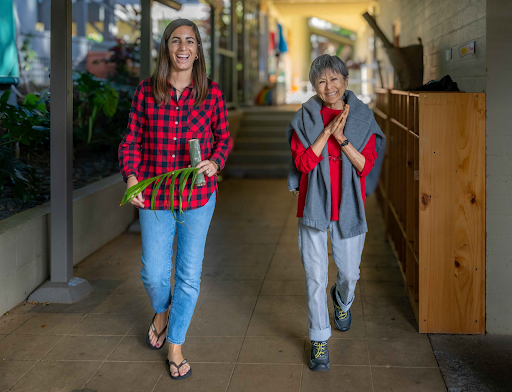
My name is Gillian Wood, and I am one of the 6th grade teachers at Hanahauʻoli School. In November of last year, my co-teacher at the time, Noreen Varney, died suddenly. She was a true progressive educator, and I feel profoundly grateful not only to have worked alongside her, but to have learned with and from her. Each school day, I experienced the joy, creativity, and the possibility this model of education can bring to life. Over time, I came to believe that this is how learning should feel for everyone: both teacher and student alike.
One of the greatest privileges of working with Noreen was witnessing firsthand the autonomy and imagination that educators can bring to curriculum design. When we lost her, I began to understand how much of her artistry lived quietly behind the orange door of our classroom. So much of what she created remained within those walls and within the many students she taught. I hope to open that door for you to share the daily wonder that unfolded in her 6th grade classroom. I hope the essence of her work continues through the legacy she leaves behind. I consider myself one of Noreen’s many students.
Although Noreen had been teaching for more than thirty years, the curricular details of each year evolved. I think that is another component of true progressive teaching. It is dynamic and gets better with time.
What we taught shifted in response to the children beside us and the world around us. The Intended Learning Outcomes remained steady, but the path toward them was never fixed. I often think of it as choosing different routes to the same destination. Some days you take the highway. Other days you opt for the scenic road. Sometimes you delay your departure to make more time for what’s in front of you, and other times you opt for the train ride so you can be fully present on the journey. The flexibility to choose your road is what makes a progressive school environment so empowering. Teachers have the freedom to respond, adjust, and guide students along paths that fit their moment.
The best way I know to honor Noreen’s work is to show it in action. So I want to share the story of a curricular unit we built together: “Future City.” It is a unit that I believe captures the nature and evolution of responsive education. We began writing about it the summer before she passed away. I wish we had finished that work together. We did not. And here we are.
I will begin with the origins of Future City and trace how it transformed over the past five years, all the way to this year, as I teach with a new co-teacher, Aubrey Fortuno.
Why Future City? How It Began.
When I taught 6th grade before teaching at Hanahau‘oli, the topic of climate change always filled me with mixed emotions. There was no denying that it was imperative for students to learn about the world around them to make meaningful decisions, but, along with this, many students were anxious when learning about the fractured state of our planet and how the humans before them negatively impacted it, leaving them to “clean it up” before it is “too late.” Of course, many students reacted to the information by wanting to make a positive difference after learning about these serious issues–for example, planning beach cleanups and pledging to live more sustainably in various ways as 6th graders do. But always, there were other students, understandably, who expressed dread, frustration, and fear. Is this really the state of the world? What is the point of trying if we are all going to die anyway? I had one student share with me in confidence that it kept her up at night as she imagined a burning planet, with a skinny polar bear clinging to a melted slab of ice. This stuck with me. Although I wanted to properly inform my students, my goal was not to scare them into lack of sleep! How does one balance the very real issues we face, while not scaring students into being fearful of the future?
Now, fast forward to my first year teaching 6th grade at Hanahau‘oli. Noreen and I sat down for our first ever planning session as new co-teachers the summer before the school year started. I was overjoyed when she expressed interest in creating a new unit that dug into technology, decision-making, and current social and environmental issues. I expressed strongly that I wanted to step into the unit looking at it in a more optimistic and empowering approach.
The concept of Future City was just an idea between us, we didn’t even write anything down. We started the year without any actual plan, and Noreen reassured me that we needed to wait and see before planning. I didn’t understand that yet–I am a teacher, and therefore a planner–but her confidence reassured me, and so we waited.
The year started. We learned about the students, and their interests. We used the first half of the year to teach units that have been in the sixth grade curriculum for years. We learned some more. They learned some, we hoped. And then finally, Noreen and I sat down again together and began to plan.
The overall purpose of the Future City unit: Empower students to find solutions for modern-day problems by creating a sustainable and equitable city of the future. This seems pretty vague, right? Exactly! That leaves the opportunity for students to direct where the project goes. We will get into that later.
We established Intended Learning Outcomes for our unit:1) There are formal and informal political, economic, and social organizations that help us carry out, organize, and manage our daily affairs; 2) People use natural resources such as fossil fuels, water, and minerals. These natural resources influence our daily lives, economy, and environment. However, they are limited and unevenly distributed across the globe, which causes conflict; and 3) People use scientific discoveries to develop technologies intended to better the human condition; these technologies impact the environment.
Through the unit, we aimed for students to consider two essential questions: 1) How can we create a more equitable and sustainable city of the future? And, simply, 2) how can we make the world a better place?
We weren’t sure what the actual unit would look like. Following the interests and direction of learners makes way for varied questions and goals, solutions to problems, and routes for demonstrating knowledge. Each year this looks different, depending on the kids. Students have discussions, conduct research, have more discussions, and brainstorm different solutions. Then they present their findings. Solutions have included writing a constitution, creating a safer road system, designing a sustainable housing unit, creating a model building of a community hub, a floating school, and more.
We embarked on this unit with the expectation that, if we planned it wisely, it should capture a wide array of middle school topics: ancient civilizations (history), scale, measurement and statistics (math), analyzing nonfiction articles and research (language arts), the scientific method (science), and more. As I live this unit each year, I realize it is not really about the content at all, although that is a sure perk. It all really comes down to one essential question: How do our values shape the choices we make?
Join me in a review of the unit’s progression throughout the years. In progressive classrooms, we learn by doing. Meaningful learning cannot be mapped in advance, and is rather living, breathing, and complex.
The First Year: Following The Interests of Students
(What Are We Doing? Is This Working? This Is Hard!)
If I could go back in time, I would have saved more student work from our original units. However, the Future City unit that we now teach is strikingly different from that initial year. We needed the first year in order to figure it out.
Truly, Noreen and I went into our first year of the unit testing the waters, and it was anything but smooth. Much of the work was trial, error, and careful observation of what worked and what did not. I think this is an essential aspect of progressive education: trying something new, learning from it, maybe failing miserably, and then returning to it from a new angle. Most importantly, we shared this process with the students. We told them that this was the very first time Future City was being taught in sixth grade and that we would need their guidance to understand what was working and what was not. Overall, students were excited to be part of being the architects of a brand-new unit and potentially creating a new sixth grade tradition.
During the first year, our focus was on responding to the challenge of designing a city that could withstand natural disasters, while students moved through the engineering and design process. Why natural disasters? This focus came directly from student-voiced concerns about extreme weather events: Hurricane Ida, a super typhoon in the Philippines, and what felt like flood after flood. One student who spent much of her time on the North Shore shared worries about beach erosion near her home and wondered whether her house might eventually crumble into the ocean. Another student, who had moved to O‘ahu from California, talked about family friends whose home had been damaged by wildfires. Another student reflected that her summer camp had burned down as a result of wildfires. They wondered whether this was connected to climate change. In our class, we had surfers, passionate animal lovers, and students interested in fashion. Naturally, questions emerged. How would climate change impact these things that mattered so deeply to them?
Much of the unit centered on class discussions and making decisions as a group. Where would we build our city? How would we protect people from environmental disasters? Ultimately, the final products took the form of physical models of buildings. Incorporating sixth grade math standards around scale and area, students planned and designed structures meant to protect against environmental hazards. Together, we created a scaled map of a fictional island, chosen by the students, that was roughly the same size and population as our home, Oʻahu. Students studied topography to determine reasonable and safe locations for their city. Over time, they also incorporated the ancient Hawaiian ahupuaʻa system into their designs, dividing the island into three districts representing land divisions from the mountains to the sea.
So why were we not completely satisfied with the first year? In many ways, we needed to experience it as a foundation in order to make informed decisions moving forward. We learned that students were deeply interested in the idea of designing a city of the future. However, in that first year, the unit did not allow for a wide range of interests to emerge. While we touched on student interests, the work largely centered on a shared, collective focus, which did not engage every learner equally. The most vocal students thrived, but others were less invested. We began to ask ourselves how we could broaden the entry points and make the learning more meaningful for all students.
Additionally, the final product, a scaled physical building placed on a map, felt incomplete. While the models were visually satisfying and students were proud of their work, something was missing. The unit lacked a sense of interconnectedness and deeper conceptual thinking. Students focused primarily on protection from natural disasters, rather than exploring the broader challenges of building sustainable and equitable communities.
The Second Year: Incorporating Science and Literature
(Now THIS is Working! But How Do We Make It Better?)
Noreen and I entered the unit in its second iteration with greater confidence. We wanted to deepen student ownership and ensure the work felt genuinely meaningful. That year, our class arrived with a strong passion for water justice, shaped by their in-depth research and nonviolent direct action around the Red Hill Water Crisis in our local community the previous year. Those studies had clearly stayed with them. Many students saw themselves as advocates for one of our most precious resources. It felt only natural to center our work on water accessibility and rights, building directly on their interests and prior learning.
Like many middle schoolers, our students also struggled to follow written directions, and I know that any educator of this age group can appreciate that challenge. Careful reading and procedural thinking are essential skills so we decided to address this skill with intention through scientific exploration. Framing water as a critical and finite resource, we designed three science labs to deepen students’ understanding of clean water access: testing pH levels of various substances, simulating an oil spill, and constructing functional water filters. Each lab required students to follow detailed procedures, generate hypotheses, collect data, and reflect on results. Alongside the hands-on investigations, students conducted research to ground their findings in real-world contexts.
Another breakthrough that year was integrating literature into the unit through an analysis of The Giver by Lois Lowry. As students moved through the Future City project, they were simultaneously immersed in the novel’s exploration of societal structure and control. The text added depth and texture to our discussions. Students began drawing thoughtful parallels between Jonas’s community and the cities they were imagining. In hindsight, it is difficult to picture the unit without it. Incorporating The Giver was like turning on headlights during a night drive– suddenly, the terrain was clearer and the questions sharper.
The novel also built on themes students had encountered in earlier texts, including A Long Walk to Water and I Am Malala. Together, these works expanded our conversations beyond infrastructure and design toward systems, ethics, and power.
The central idea students examined in The Giver was this: societies and their systems can either expand or restrict individual freedoms in the name of collective well-being. From that premise, our discussions widened. How do social structures and individual citizens shape one another? How do we balance personal freedom with communal responsibility? How should science and technology be used, and who decides?
Looking back, I cannot imagine teaching Future City without this integration of science and literature. The combination elevated the quality of our conversations and strengthened students’ ability to think across disciplines. Instead of simply designing buildings, they began designing systems. Instead of solving isolated problems, they wrestled with the ethical and social dimensions of their decisions.
The Next Two Years: Student Ownership, Values, and Governance, and Incorporating the Sustainable Development Goals
(They’ll Build a Better Future For Us All! We Got This!)
With experience, the third year of implementing the Future City unit was much more cohesive and “just felt right!” The following years, students showed a strong interest in science and were able to move at a quick pace, while still diving in deeply as a class, so we introduced the water science labs before the Future City Unit even began to establish important background knowledge before delving into the unit. This allowed students to have that common background knowledge to refer to as they planned the unit.
This year, we added research on the United Nation’s Sustainable Development Goals (SDG’s). Again, just like incorporating the science and literature, incorporating the SDGs greatly elevated the unit by diversifying specialties, so that students could work toward a common goal but from different angles. This was the missing piece! To set it up, students researched the SDGs and chose one they connected most with to be the “expert” of. For example, one student’s strong interest in economics and finances drove him to choose SDG 8, “Decent Work and Economic Growth.” Two other students had a passion for history and politics, so they chose SDG 16 “Peace Justice and Strong Institutions.”
We also added an important missing piece: the concept of values. How do values inform our decisions? They are the guiding principles that shape the choices we make as individuals and as a group. At the start of the school year, students share their personal values with the class and then vote to select three class values. These values connect to the legacy they hope to leave behind before graduating from Hanahau‘oli and moving on to new schools.
Incorporating this concept into the Future City unit, students considered the question: “As you plan a city of the future, set to open in 2050, it is important to consider the values of your city. Brainstorm at least three values that you think are important when planning your city. These values should be separate from sustainability and equity, as they are already assumed for this city.” Much like our class values, establishing city values helps students make intentional decisions as they work to solve complex problems.
Today:
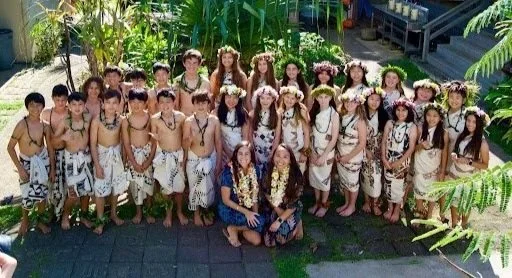
Approaching my fifth year of the Future City unit felt strange without my treasured design partner, Noreen. I am back in the same 6th grade classroom, behind the same orange door, at the same time of year, yet so much has changed. Noreen is not here. And I am not the same teacher I was before. How would I honor the way Noreen taught while also empowering a new co-teacher and a new group of students?
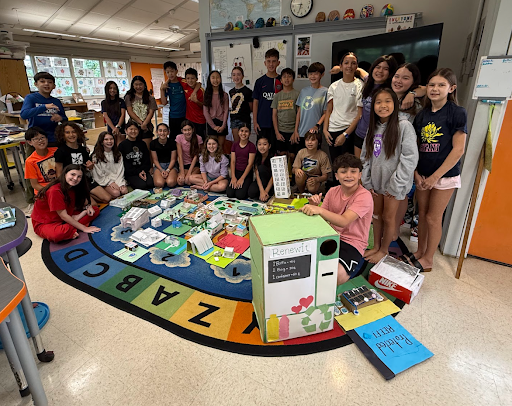
Yet, when we arrived at Future City this year, the process just felt right. Aubrey is a strong co-teacher, adding valuable insight with a fresh perspective, positive energy, and truly knowing our students. We listened to students. They took ownership quickly and pursued their ideas with certainty. They discussed, questioned, researched, and made decisions with confidence and curiosity. We added new layers to the work: a tiny house project woven into sustainability and geometry, deeper research on infrastructure, and a study of ancient Rome, Mesopotamia, the Middle Ages, and the Industrial Revolution as we explored the history of cities.
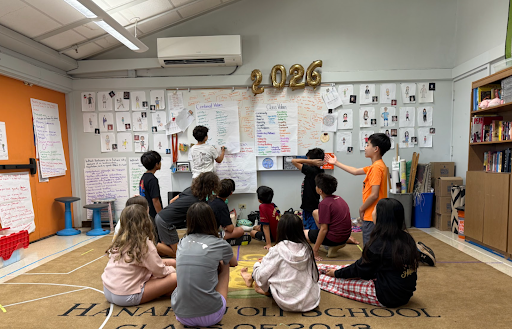
Then, the discussion on values happened. It lasted for three class periods, much longer than we had expected. Students went back and forth: What is important to us? What will be important when guiding our choices for a city that doesn’t even exist yet?
And then, they made their decision as one united class. As I listened to them outline three essential values they couldn’t live without in their future world, familiarity rang within me. I realized the values were the same ones Noreen modeled every day behind the orange door. They are the values that have come to guide my own teaching and learning. They were the basis for our development of the Future City unit.
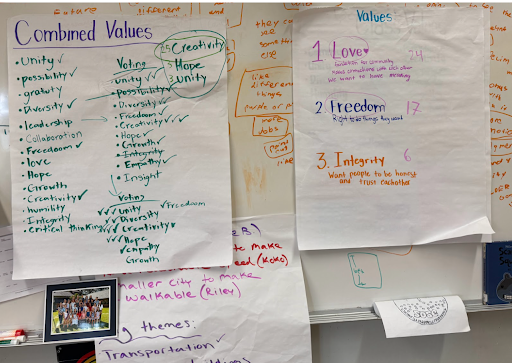
The details of the unit will continue to change. The students will change. I will change. The world will change. But these essential values will always remain:
Love. Freedom. Creativity.
ABOUT THE Contributor:
Gillian Wood is a 6th Grade Teacher at Hanahauʻoli School. She is passionate about creating a safe and dynamic learning environment for students to ask questions, take academic risks, and engage in meaningful discussions and learning experiences. She holds a bachelor’s degree from The Pennsylvania State University and a Master of Science in Education with an emphasis in Elementary Education from Johns Hopkins University.

