
By Federica Gallone and Federica Lentini
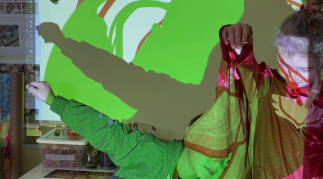
We are Federica Gallone and Federica Lentini – two educators who feel most alive when we are learning with children. Our professional lives have unfolded in early childhood settings, where relationships, curiosity, and wonder shape our days. We have worked closely with children as teachers, atelierista, and pedagogista, accompanying students’ thinking through materials, dialogue, light, and documentation. Our classrooms and studios are spaces of research—places where questions remain open and children’s ideas are made visible, respected, and revisited.
We come from Italy, and our professional roots are deeply connected to the city of Reggio Emilia, where we had the privilege of working alongside Reggio children and educators. There, we lived the Reggio Emilia Approach not as a theory, but as a daily, relational practice grounded in listening, collaboration, and shared responsibility.
Our journey toward the Reggio Emilia Approach was not a single moment, but a gradual falling in love. It began with images of children deeply engaged in their work, with documentation that honored children’s voices, and with the poetic resonance of the “hundred languages.” Over time, through study, reflection, and practice—as educators, atelierista, and pedagogista—this approach became not only a professional framework, but a way of seeing children, learning, and ourselves.
What is the educational philosophy of the Reggio Emilia Approach? How is it similar or different to progressive education?
At its heart, the Reggio Emilia Approach is built on a profound trust in children. Children are seen as capable, intelligent, and rich with potential from the very beginning. Learning is not something that is delivered to them; it is something they construct through relationships—with peers, educators, materials, and the world around them.
This philosophy values listening as an educational stance. Educators observe closely, document thoughtfully, and design environments that invite exploration and dialogue. Learning unfolds through long-term projects driven by children’s questions, theories, and interests. Expression is not limited to words—children think and communicate through movement, drawing, building, sound, light, and many other languages.
The Reggio Emilia approach and progressive education overlap significantly, as Reggio Emilia is considered a concrete, internationally recognized application of progressive, child-centered philosophy. Both systems reject traditional, lecture-based instruction in favor of learning that is driven by the child's curiosity, community-focused, and experiential. Some of the key connections between Reggio Emilia and progressive education are:
The Image of the Child as Competent. Both approaches view children not as empty vessels to be filled with knowledge, but as active, capable, and intelligent agents of their own learning. They believe children are born with a natural, driving curiosity and the capacity to explore and construct their own understanding of the world.
Child-Led, Project-Based Curriculum. Instead of a strict, standardized curriculum, both philosophies emphasize emergent curriculum, where projects and topics arise from the interests, questions, and theories of the children. In Reggio Emilia projects can last for days, weeks, or months, evolving based on children’s investigations. Progressive educators focus on experiential learning, allowing children to take charge of their educational experiences.
The Role of the Environment. Both philosophies treat the physical environment as a "teacher" or a vital, pedagogical tool for learning. In Reggio Emilia classrooms are designed to be aesthetically pleasing, filled with light, and utilize natural materials to encourage exploration and collaboration. Progressive educators emphasize open spaces that allow for hands-on, collaborative, and self-directed activity.
"The Hundred Languages" and Creative Expression. Reggio Emilia’s famous "hundred languages" concept—that children have many ways to express, explore, and connect their thoughts (e.g., painting, music, drama, construction, shadow play)—strongly aligns with progressive education’s focus on fostering creativity and multiple intelligences.
Education as a Collaborative Process. Both models stress that learning is a social endeavor, not an isolated one. Teachers are seen as guides, co-learners, and observers rather than lecturers. Families are considered essential partners in the educational process. Both emphasize peer-to-peer interaction and social responsibility.
Documentation vs. Traditional Testing. Both approaches avoid traditional testing and grades for young children. Instead, they use documentation—photos, videos, transcripts of conversations, and portfolios—to make learning visible, track progress, and reflect on the educational process.
Emphasis on Democratic Values. Both philosophies are rooted in democratic principles, focusing on fostering empathy, fostering a sense of belonging, and encouraging children to become contributing members of a community.
What are “digital landscapes and the languages of technology” in the Reggio Emilia Approach?
In April 2026, we will be holding a two-day workshop series at the Hanahau‘oli School Professional Development Center titled, Digital Landscapes: The Languages of Technology in the Reggio Emilia Approach. In a Reggio-inspired context, digital tools are not gadgets or screens to manage children’s attention. They are languages—materials that can help children see, wonder, revisit, transform, and deepen their thinking.
“Digital landscapes” are spaces where analog and digital experiences meet. A child might observe the veins of a leaf through a digital microscope, project a shadow that grows and changes with movement, or use photography to capture a detail that caught their eye during outdoor play. These tools invite slowness, curiosity, and reflection. They allow children to return to their ideas, to see them from new perspectives, and to share them with others. Technology becomes another way for children to narrate their thinking—alongside clay, paint, wire, and blocks.
Both workshops in our upcoming PDC series will propose not only digital tools, but a pedagogical perspective: how to support children’s creativity, thinking, and doing, valuing their point of view and the process of discovery. Participants will learn how technology does not replace direct contact with the world, but becomes a complementary language that expands possibilities for expression, documentation, and meaning-making.
Why is this work needed?
We believe this work is needed now more than ever. Children are growing up in a world where digital and physical realities are deeply intertwined. The question is not whether technology belongs in early childhood, but how it is introduced—and with what values.
When approached with care, intention, and respect, digital media can enrich children’s creativity rather than replace it. It can support deeper observation, collaborative meaning-making, and powerful documentation. Most importantly, it can help educators honor children’s thinking by making it visible and shareable.
Our workshops will be an invitation—to slow down, to look closely, and to imagine technology not as a distraction, but as a poetic partner in children’s research. It is about holding space for wonder, possibility, and the many languages children use to make sense of the world. Please join us!


ABOUT THE Contributors:
Federica Gallone was born and raised in Italy. After completing her studies, she earned a Bachelor’s degree in Scenography from the Academy of Fine Arts in Lecce and then moved to Milan to specialize in Product Design at the Brera Academy of Fine Arts. She continued her education at the University of Bologna, graduating in 2017 in Drama, Art, and Music Studies. Before moving to the United States, she had the privilege of working at the Centro Internazionale Loris Malaguzzi in Reggio Emilia and at a private school in Milan following the Reggio Children pedagogical project. These experiences allowed her to intertwine theory and practice, deepen her pedagogical perspective, and collaborate closely with outstanding educators and atelierists. She currently lives and works in San Francisco, where she serves as an Atelierista specializing in the Reggio Emilia Approach at La Scuola International School with strong ties to Italian language and culture. In this role, she guides preschool children through creative research projects using the languages of art, science, and technology, with particular attention to light, sound, digital media, and material exploration. She also provides educator training and pedagogical consulting, always emphasizing the aesthetics of learning and the quality of educational environments.
Federica Lentini was born in Torino, Italy and spent her first 25 years there before moving to the United States. She is in her eleventh year in educational leadership, and draws upon roles in the classroom as head teacher and running music programs that engage children with caregivers, as well as at the administrative level as an early childhood and K3 Director. She received a masters degree in Clinical Psychology from “Universita’ di Torino” in 2005, is a licensed Psychologist, and has engaged in university-level research with children with special needs, as well as children and adults with “Internet Addiction” and attachment disorders. As the Assistant Head of School for Teaching & Learning at La Scuola International School and Director of the California International Reggio Center, Lentini is able to focus on her passion for early childhood education. She is an accredited Site Supervisor/ Program Director, which allows her to work in collaboration with teachers and administrative staff to design, implement and evaluate a developmentally appropriate Reggio-inspired and IB PYP program. She feels honored to lead a school with such persevering students, an extremely dedicated staff, and a supportive school community.

