
By Crystal Y. Jolley
I am an early childhood educator who has been working with children and families for over twenty years. I consider myself a life-long learner, and in the last four years have immersed myself in investigating what it means to be a “progressive” early childhood educator. Being a life-long learner lends itself to discomfort. This journey has been unsettling at times, but in my time at Hanhauʻoli, I found author Angela DiTerlizzi’s book The Magical Yet to be a helpful resource for both my students and I. It’s a book read to our K/1 students at the beginning of every year, and it explores all the fantastic goals you haven’t accomplished yet. For both me and my students, it serves as a reminder that we are all growing, learning, and just because you can’t do something now, that doesn’t mean that it’s fixed and that you can’t do something always; it just means you haven’t done it, yet. On even the most difficult days of teaching, the message in the books helps me realize that with practice, patience, and positive inner dialogue, I am in the process of becoming a progressive educator.
In this blog, I share more about my process of becoming. I do this by focusing on the self-discovery and reflection that emerged during the 2025-26 school year when my fellow teachers and I worked alongside the Hanahau‘oli School leadership team to design a “teacher evaluation” uniquely aligned to Hanahau‘oli’s progressive education mission. This included examining our School-Wide Learning Outcomes, creating a set of “Core Practices” that describe what it means to be a progressive educator at Hanahau‘oli School, and generating Indicators to illustrate what each Core Practice looks like in action. Next, we experimented with using the Core Practice Indicators to generate a professional development SMART (Specific, Measurable, Achievable, Relevant, and Time-bound) Goal for the 2025-26 school year. When selecting my SMART goal, I knew I wanted to work on (a) designing and implementing a lesson that I could deeply reflect on through the lens of progressive philosophy and pedagogy; and then (b) share about that experience through a blog post on the Professional Development Center’s website. So here I am!
Generating a SMART Goal to Help Me Meet my Yet
In the 2025-26 school year I decided that I wanted to focus on designing, implementing, and assessing joyful progressive education learning experiences (Core Practice 1). More specifically, I wanted to collect evidence on the progress I was making towards: explaining the progressive philosophy and pedagogy that informs how I design, implement, and assess joyful and progressive learning experiences. To support this work, I developed this SMART goal:
By the end of the 2026 Spring semester I will write a blog post for the PDC detailing an experience in my classroom from planning, to execution, to reflection, thereby highlighting my growing understanding of progressive philosophy and pedagogy.
To accomplish this goal, I collaborated with colleagues to further develop a lesson I had started while participating in a Leaders in Social Justice Education course. This lesson started with my desire to introduce young learners to Mahina ʻŌlelo Hawai‘i (Hawaiian Language History Month) and Black History as a part of the Hanahau‘oli School K/1 Communications Unit. This unit focuses on the core concepts of Basic Needs / Interdependence / Change and Constancy, and the following Instructional Learning Outcomes (ILOs):
understanding why we communicate and that there are many forms of communication;
understanding that technology for communication changes over time; and
understanding the authoring and publishing process.
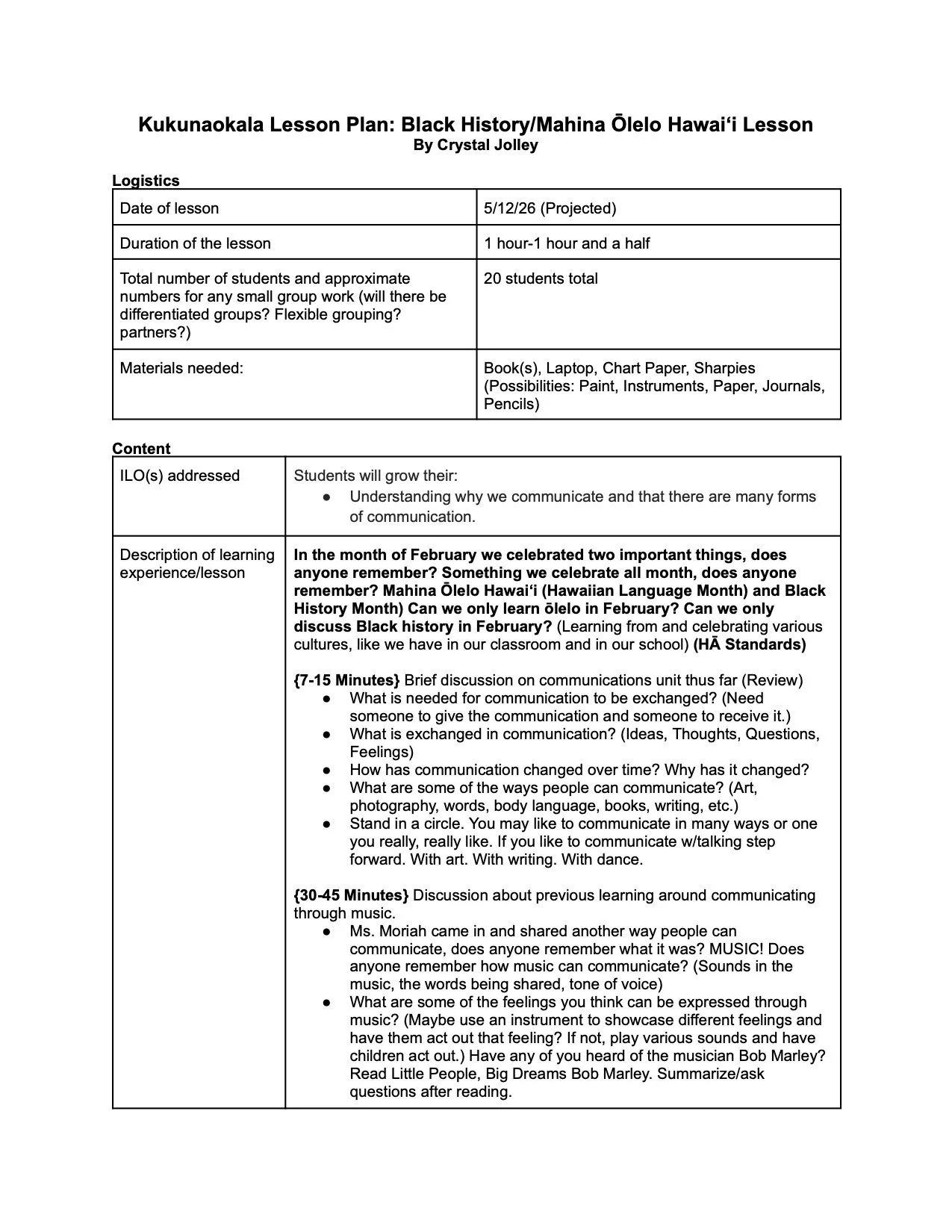
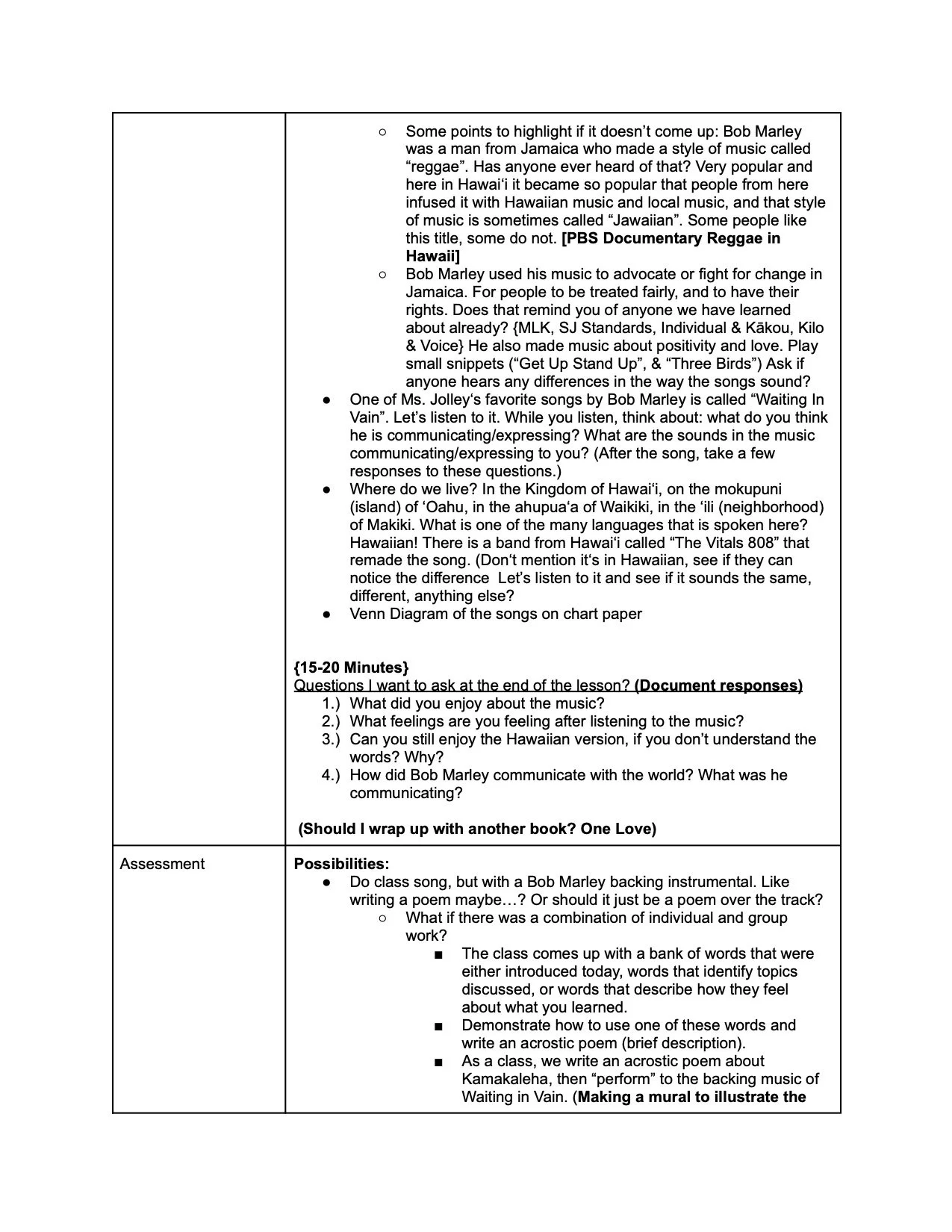
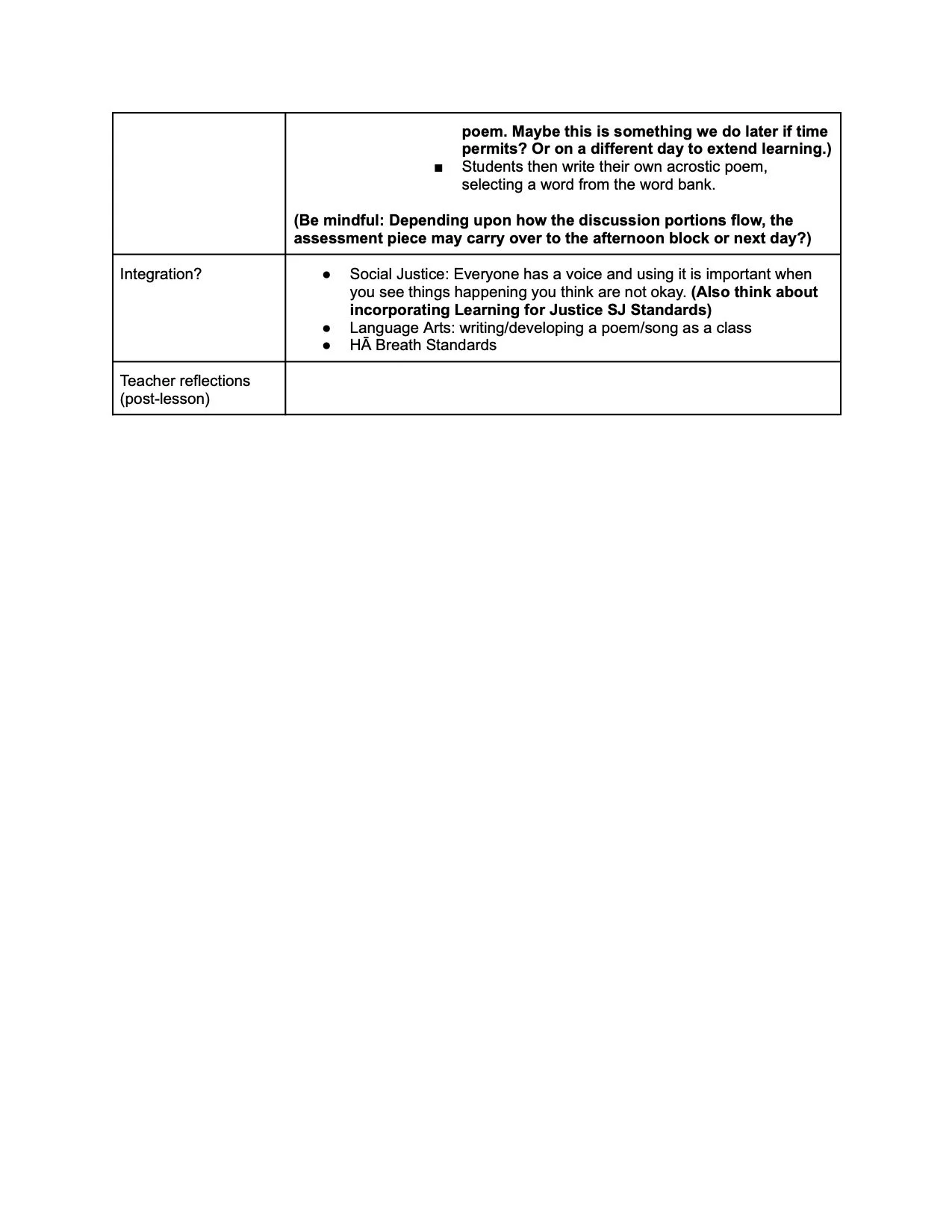
To address the first learning outcome above, children learn that communication is an exchange of feelings, information, questions, and thoughts. Additionally, they learn how communication has evolved over the years and about a variety of ways to communicate: dance, sign language, photography, art, books, body language, and music, just to name a few. I have a deep love for music so I harkened back to this and got to work on developing a lesson that would introduce students to the song Waiting in Vain by Bob Marley, and the ōlelo Hawai‘i version, Kali Ana Au sung by local band, The Vitals 808. Here is a copy of the lesson I developed: Black History/Mahina Ōlelo Hawaiʻi Lesson.
Designing the Lesson
To design this lesson, I grounded myself in the unit’s existing ILOs and asked: How will I be sure children understand why we are communicating and that there are many ways to communicate? How will I showcase music and words (voice) as a form of communication? How will I assess this? I met with my thought partner, Jennifer Stierli, our Director of Faculty and Curriculum in the Lower Grades and shared the skeletal structure of my plan. She asked questions that allowed me to think deeper. I then delved into the Nā Hopena Aʻo (HĀ) framework and the Learning for Justice Social Justice Standards, focusing on how these could serve as guideposts for the experiences we were designing for children and the tools we would use to assess them. Lastly, I looked at a number of our newly developed Hanahauʻoli School Guiding Beliefs to help frame the lesson.
At the lesson’s core, students are asked to explore the ILOs in our Communications unit by focusing on the tension that arises between Individual & Kākou and Kilo & Voice. I wanted to help illustrate to the children how their own personal understanding of something is meaningful and how they can use that to work together for the betterment of their space, place, and the world. I also wanted to help illustrate for the children how their observations of what is happening in their world is valuable and how using those observations in conjunction with their voice to speak about what they are observing can be incredibly powerful. “We kilo to learn and learn to use our voice, developing perspective, compassion, and adaptability.” (Hanahauʻoli School, n.d., "Kilo & Voice" section).
Teaching the Lesson, Learning from Children
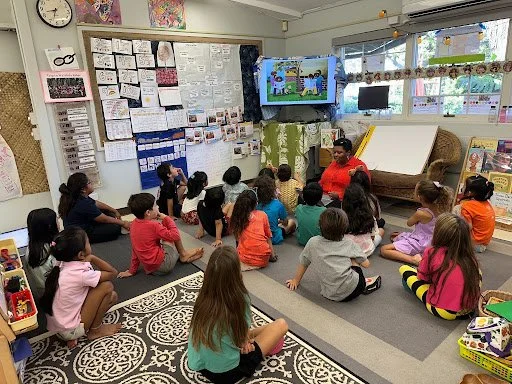
To launch the lesson, students and I began by reflecting back on various cultural celebrations we had in our classrooms and the significance of the month of February. We talked about, in addition to Valentine's day, how February is Mahina ʻŌlelo Hawaiʻi and Black History month. Next we reviewed our unit of study for the semester, Communications. I asked what is needed for communication to take place and what can be communicated. I used this “windshield check” (formative assessment) to evaluate in real time the students' understanding of what was being presented, and what areas they may need to develop. This initial discussion at the start of the lesson gave me lots of evidence of the students’ evolving understanding of the communications unit ILOs, and allowed us all to reflect deeply on the students’ initial ideas about the power of their voice, how they can use their voice to communicate, and what they can communicate through their voice.
Next, we read Little People, BIG DREAMS Bob Marley, by Maria Isabel Sanchez Vegara. As a part of this dialogic and interactive read-aloud, we made connections to prior lessons about Rev. Dr. Martin Luther King. This was the perfect segway to playing and listening to Bob Marley’s Waiting in Vain song and the ʻōlelo version, Kali Ana Au (Waiting in Vain). I asked the children to pay close attention to the words and sounds of the music, and what they thought was being communicated. (Afterwards, we danced!)
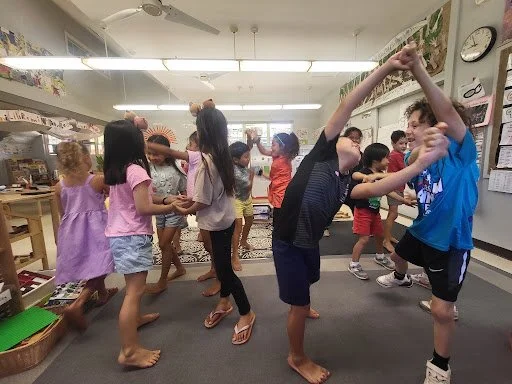
As a follow-up to the read-aloud and songs, the students and I co-constructed a Venn Diagram to reflect on what we learned. This is a tool we had used in lessons before. For children this age, it provides a concrete visual of how things are “same-same, but different,” and a chance to compare and contrast, highlighting and celebrating similarities and differences. Afterwards, each child shared a word to describe the experience (which I charted) with the intention of creating a word bank to select one word to write an acrostic poem as a class about the experience and lesson. Then the class voted for which word they wanted to pick, with “Mellow” receiving the most votes.
What I Learned About Progressive Philosophy and Pedagogy
One eye-opening takeaway for me was observing how the values and tenets of progressive philosophy and pedagogy work in tandem. Alfie Kohn (2015) lists the defining features of a progressive education as: attending to the whole child, community, collaboration, social justice, intrinsic motivation, deep understanding, active learning, and taking kids seriously. When I was new to progressive education, these various aspects of the approach seemed to be siloed in my mind. However, as I reflected on this lesson, I began to see how they are so connected and reinforce one another tremendously! Through the process of analyzing the lesson’s objectives, student outcomes, and the professional learning goal I had created as a part of our new Hanahau‘oli School teacher evaluation process, my understanding of how to integrate the pillars of progressive education and how to translate theory to practice through lesson planning and implementation were thoroughly strengthened.
The Instructional Learning Objective (ILO) for my lesson was: Children will grow their understanding of why we communicate and that there are many forms of communication. To meet this objective I designed a lesson that incorporated:
Attending to the whole child: experiences that required students to practice counting, listening to literature, generating words for our poem, identifying emotions, engaging kinesthetically, acknowledging their own cultural background and learning about the diverse experiences of others
Community and collaboration: experiences that required students to engage in dialogue and discussion about how and why Bob Marley communicated; sharing and listening to the thoughts and feelings of peers, thereby supporting their learning from one another in a safe, caring space, then working together to author an acrostic poem
Active learning and taking kids seriously: experiences that required students to construct ideas with others, and I took cues from the children and designed the learning alongside them, both as individuals and as a group
Social Justice: experiences that required students to discuss what it means to use their voice to advocate for themselves and others and why that is important as well as the celebration and appreciation of the culture and language of their home and place.
As a result of the experiences provided in the lesson, children learned about the history of an artist and activist who impacted and inspired the broader world through his music, which also inspired and impacted people here in Hawaiʻi, their own place and home. They learned how someone advocated for change in the world, and how they too can advocate for change in their world. I observed how the students developed empathy by listening to music in ōlelo Hawaiʻi, which reflects attending to the whole child. Children were asked to reflect and share constantly throughout the lesson; what they learned about Bob Marley, what and how they felt about his music, how he was communicating, and why. These discussions encouraged them to dissect and share their thoughts, ask questions, and maybe even amend or improve understandings, in a safe place, together, thereby fostering deep understanding and community. Children worked together to create an acrostic poem. Prior they each contributed a word for a word bank, then voted on their favorite word, all displaying collaboration. (Additionally, collaboration with my thought partner allowed me to think deeper about my lesson and bring in other frameworks to guide me.)
As I reflected on the student growth exhibited during this lesson, I realized that collaborative work is valuable and significant for students because it also helps to create a sense of community. Since joining the faculty at Hanahau‘oli, I’ve learned that collaborative learning environments are integral to progressive schools. Through their participation in socially constructed learning, children are able to develop care for and appreciation of someone in the broader world, someone who maybe doesn’t look like them, sound like them, or belong to the same culture as them. In this lesson, I observed how students came to see the ways in which Bob Marley used his voice to fight for change and how they could also do the same, promoting social justice. These ideals are all so deeply embedded in progressive philosophy and pedagogy, and the approach helps students show up in the world with more curiosity, compassion, connection, and desire to use their voice and actions in support of others.
My overall summation of the class learning experience as a whole is that the lesson engaged students in deepening their understanding of the unit’s ILOs and the overall concepts guiding the unit (Basic Needs / Interdependence / Change and Constancy). Through the specific example of Bob Marley–how he used music and voice to communicate and effect change in the world–the students further developed their understanding of why we communicate and that there are many forms of communication. They left the lesson with an increased awareness that they can use their voice to communicate and effect change in the world. These takeaways are definitely aligned with the core values of a progressive philosophy and pedagogy (Kohn, 2015).
Why Write?
For me, I’ve always found writing to be an excellent (and preferred) form of communication. When I write, I feel like I allow myself to be more honest, more open, more vulnerable. I ultimately knew this process would be challenging and essentially compel me to expose not only what I’m doing well in my practice, but the areas where I am looking to grow. I knew it would force me to face challenges, work toward improving them, and ultimately help me to refine my teaching practice, especially since I do not feel “fully developed” as a progressive educator, yet.
The writing process has helped me lean into the power of my own Magical Yet. As I composed drafts, got feedback, rewrote and reconsidered what I was learning, I started giving myself more grace, more patience. Going through this process, as well as reflecting back on my time at Hanhauʻoli thus far, has also encouraged me to embrace more and more that I’m in the learning phase, I’m not there quite yet, and that’s okay. I’m taking this valuable opportunity to allow the knowledge of my seasoned colleagues to be a benefit to me and my practice; observe, listen, ask questions, research, make mistakes, and most importantly, reflect. This is a fact that doesn’t just apply to our students. “Deep learning takes place in the reflection, and that’s what progressive education is all about.” (The Cambridge School of Weston, 2020) Being more vulnerable, more open, more reflective allows me to know where I’m at in reaching my goal, where I want to get to, and ways in which I can further achieve my goal.
The writing process has also provided me an opportunity to get deeper into my “Why” of progressive education. Why is this particular philosophy unique and powerful and long-standing/time-honored? Why do I feel drawn to it? From my perspective as an early childhood educator, I really appreciate the focus on developing the whole child, following the children's lead, the importance of social-emotional learning and well-being, and engaging in hands-on activities. All these things really resonate with me, but there are many philosophies that embrace some, if not all, of these. So again, why progressive education? One thing that has certainly impacted me as I have learned about progressive philosophy and pedagogy is the idea that learning does not merely exist so it can be applied later in a child’s adult life; learning is for their lives, in the now! It’s about making connections to their world in the present, asking questions about their world in the present, and growing an understanding of their world and how they exist inside of it in the present, all of which supports their development as critical thinkers. “Dewey believed that education should not only transmit knowledge but also foster active problem-solving, critical thinking, and civic engagement.” (The Crenshaw Academy, 2025, "Understanding Progressive Approaches" section). I wholeheartedly agree!
Thank you for coming along with me on this journey of reflection and writing. I am so grateful for the opportunity to be curious and really put lifelong learning into practice, another tenet of progressive educationʻs philosophy. This blog has helped me flesh out my thoughts, interrogate my opinions, and practice being a teacher researcher. I am so appreciative for this opportunity to learn, expand my knowledge, further develop my practice, and challenge myself.
In conclusion, as it is emphasized in The Magical Yet, missteps and mistakes have been important points of growth that led me to where I am now. Reflective practice throughout the process is the key to evolution. This entire process has thoroughly supported my maturation in understanding progressive philosophy and pedagogy, and it is a reminder to be kind with myself during this time of growth. Through the planning process, the implementation of the lesson (where I did make some mistakes), and the reflection process, there were times when I felt like wow, things are really starting to click and I’m understanding more. There were also times when writing this I really wasn’t quite secure in my ability to complete it. But look at that, I did! I might not be there, yet, but I’ll keep at it. Have I learned it all? Not yet. Will I make more mistakes? Likely. However, how I acknowledge them and use them to progress forward is where my true growth lies. Even more so, I look forward to the continued development of my very own Magical Yet as a progressive educator!
Works Cited:
Hanahauʻoli School. (n.d.). Our mission & beliefs. https://www.hanahauoli.org/mission
Kohn, A. (2015). Progressive education: Why it's hard to beat, but also hard to find. Bank Street College of Education. https://educate.bankstreet.edu/progressive/2
The Cambridge School of Weston [@cswschool]. (2020, October 2). 3 misconceptions about progressive education [Video]. YouTube. https://www.youtube.com/watch?v=lwnXRVAnVis
The Crenshaw Academy. (2025, February 5). Comparing educational approaches: Traditional vs progressive learning. https://thecrenshawacademy.com/blog/comparing-educational-approaches-traditional-vs-progressive-learning
ABOUT THE CONTRIBUTOR:
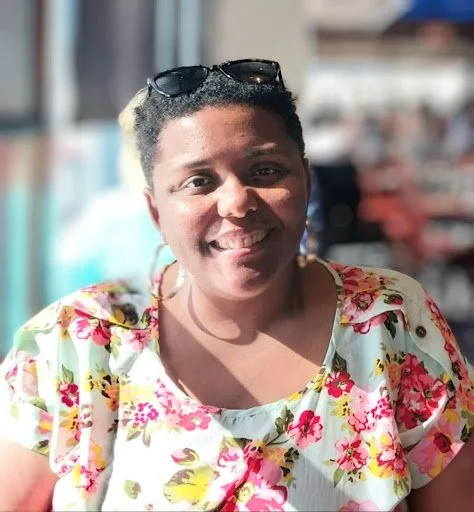
Crystal Y. Jolley taught Kindergarten and first grade for two years at Hanahauʻoli School and is teaching Junior Kindergarten in the current 2026-2027 school year. She received her Bachelor of Arts in Psychology from the University of Massachusetts Amherst in 2004, and then her MEd-ECE (Master of Education in Early Childhood Education) from the University of Hawaiʻi at Mānoa in 2014.
The majority of her 22-year career has been spent teaching in early childhood classrooms, but she has also worked in the social services field in a boys group home and in the child welfare system. She has a deep passion for social justice and enjoys sharing that with children and our community. She has come to deeply value learning more about progressive education at Hanahauʻoli in the same vein that is taught to children, “learn by doing.” When not teaching, she enjoys attending live music events, spending time with loved ones, and laughing as much as possible!

