
By Amber Strong Makaiau
Historically, progressive education schools and institutions have generally rejected traditional, high-stakes teacher evaluations based on standardized test scores. They tend to favor collaborative, qualitative growth models that focus on peer review, reflective practice, and portfolio assessment, rather than ranking or punishing teachers with rigid metrics. Today, this progressive education stance on teacher evaluation is increasingly supported by research, such as a national study from the Annenberg Institute at Brown University titled The Effect of Teacher Evaluation on Achievement and Attainment. In this study, Bleiberg (2021) and colleagues conclude that post-2009 state reforms instituting high-stakes teacher evaluations yield null effects on average, showing no measurable improvement in student test scores or educational attainment. Knowing that standardized accountability-based teacher evaluations or consequential performance appraisals tied to student test scores do not improve teaching and ultimately student learning, what might a more progressive approach to teacher evaluation look like?
This is a high-level question that Hanahau‘oli School leadership and faculty have been tackling over the past two years. In 2024, the school engaged in a self-study school accreditation process facilitated by the Hawaii Association of Independent Schools (HAIS), and identified faculty evaluation and growth as an area of opportunity, challenge and need for Hanahau‘oli School. The accreditation team tasked the faculty and staff with the following: Using the variety of tools explored for teacher evaluation and with new professional support from the Directors of Faculty and Curriculum, the administration and faculty can seek ways to build out and formalize teacher performance and promote professional growth. Written guidelines and expectations could be developed with input from faculty/staff and leadership. As a result, the school created a self-selected inquiry-led committee that generated this more specific question to drive their work: How might we align our mission statement and guiding beliefs with our learning outcomes and teacher core practices to inform faculty evaluation and inspire growth? I was a member of this committee, and in this blog post I want to share more about the outcomes of our work, including the process we went through as a school to design the beginnings of a progressive education teacher evaluation.
Step I: Framing the Work and Identifying the Core Practices
After reviewing the accreditation recommendations as a school and establishing committees to take the lead in particular areas, our teacher growth and evaluation committee decided an important first step was to frame the work ahead. Above all, we wanted the faculty to know the purpose of our committee was not to know all of the answers, but to help guide a collaborative and co-constructed inquiry focused on how we collectively define and measure good teaching at Hanahau‘oli School. To kickstart the investigation, we all read A Progressive Approach to the Education of Teachers: Some Principles from Bank Street College of Education written by Nancy Nager and Edna Shapiro. The opening line in this paper states, “a vision of good teaching must inform decisions about how to prepare teachers to meet the needs of children in schools” (Nager & Shapiro, 2007, p.7) and we believed that a shared vision of good teaching at Hanahau‘oli School was needed to inform the decisions we were jointly tasked with making about teacher evaluation at our 108 year old progressive school. The publication provided a great model of the Bank Street College of Education approach to teacher preparation, which is centered on five interrelated principles: (1) promoting social justice and democracy, (2) deep subject matter engagement, (3) understanding child development within cultural contexts, (4) continuous personal and professional growth, and (5) building an explicit, reflective philosophy of education. In our faculty-wide discussion of the article, we knew that our “core practices” or interrelated principles that help to define what it means to be a teacher at Hanahau‘oli would be different, but seeing the way Bank Street clearly and concisely defined their core tenets gave us a road map and mental picture of what we were aiming to do.
From there, our committee performed a careful analysis of the characteristics of a Hanahau‘oli graduate (the school’s learning outcomes) and identified six Core Practices of a Hanahau‘oli teacher. After a few iterations, we decided they are:
Core Practice 1: Designing, Implementing, and Assessing Joyful and Progressive Learning Experiences
Core Practice 2: Growing as a Person and a Professional
Core Practice 3: Cultivating Critical and Creative Thinking
Core Practice 4: Building a Professional and Collaborative Community
Core Practice 5: Connecting School Life with Home and Community
Core Practice 6: Supporting Each Child’s Development

We then took the list to the faculty, and asked them to play around with Core Practices to “test” them out.
Each faculty member was given a graphic organizer that had a section for each Core Practice, and they were asked: How do you engage in this practice? They were also required to cite concrete evidence to support their claims. Then, the two Directors of Faculty and Curriculum set up a conference time with each faculty member to listen to their Core Practice celebrations, to hear evidence of that core practice progress, and to provide feedback.

The Directors of Faculty and Curriculum took notes during these conferences and analyzed what they heard. They identified celebrations and areas where the initial list of Core Practices needed to be improved. At our next faculty meeting, they shared the through lines and new insights that emerged from the conferences and feedback. We refined the Core Practices to the bulleted list above and identified the need to create Core Practice Indicators as an important next step.
Step II: Generating and Refining the Core Practice Indicators
Now that we had a list of six Core Practices that all teachers at the school agreed were at the heart of their work, we needed to spend more time really defining each core practice. In a faculty meeting we formed small groups with a mixture of administrators, faculty, teacher candidates from the University, and long-term subs. The groups were then randomly assigned one of the six Core Practices and asked to generate one- to two-sentence descriptions explaining what the Core Practice looked like in action. This was a dynamic and engaging process that generated a number of unique descriptors for each Core Practice.
Then, we invited Specialist teachers to review what had been written and propose indicators that were more closely aligned with their unique work. After the Specialists had a pass at the descriptors, our committee began the work of taking the indicators the faculty generated and doing a thorough read-through of our emerging Core Practice Indicators document. We looked at the refreshed mission statement, guiding beliefs, and overall principles of progressive education to ensure that there was connection, alignment and that we had enough indicators to thoroughly describe each core practice. This work was completed during the summer of 2025.
We began the 2025-26 school year with a comprehensive document in hand that listed each Core Practice and the accompanying indicators that helped to describe the practice in action. We asked the faculty to read through the document and provide reactions in a form asking: Which Core Practices do you demonstrate consistently? Which Core Practices were you unclear on? Based on the feedback, our committee revisited the Core Practices document to modify indicators that were unclear.
At our next faculty meeting, we read through the marked-up document and revealed the final draft. We asked faculty to highlight the areas they believed they demonstrate consistently. At the close of the meeting, faculty identified one Core Practice indicator to focus on and we asked them in the months ahead to find evidence to illustrate the progress they were making toward it in their day-to-day teaching. We asked them to bring this evidence to our next meeting.
Part III: Moving From Defining to Evidence Gathering, Goal Setting, and Evaluation
In October of 2025, we engaged in a faculty-wide Gallery Walk. To shift the work from defining what we mean by good teaching and learning at Hanahau‘oli School to learning how to use our criteria for self-evaluation and professional growth, we laid out the following guidelines:
Display your work: Set up a space where you can “post your work and/or display artifacts” of the evidence for one Core Practice Indicator that you demonstrate consistently. This space should (a) state the Core Practice Indicator and (b) have samples of evidence.
Observe and provide feedback on the work of your peers: Walk around the room silently and take time to review your colleagues' work. Write comments and questions on sticky notes, which you will post next to the work displayed. Suggested prompts include:
This evidence illustrates the way you demonstrate this indicator because…
I’m confused about this evidence because…
Have you thought of…
I liked…
I wish…
I wonder…
I could apply this in my practice by…Generate a list of the types of evidence on display: Let’s work together to create a list of the types of evidence that we observe to be particularly good for demonstrating progress toward the Hanahau‘oli School Teacher Evaluation Core Practice Indicators. This list will help us identify the types of evidence we will use to illustrate the progress we are making toward our individual SMART goals.
Faculty participation in this Gallery Walk and Reflection experience was spirited, energetic, and productive. It provided a great segue to the goal setting that commenced at the start of the following new year.
At our first faculty meeting of 2026, all faculty members conducted a self-assessment of their practice using the Core Practice Indicators and generated a professional development SMART Goal for the Spring 2026 semester. We explained how everyone’s goal needed to be: Specific, Measurable, Achievable (or Attainable), Relevant (or Realistic), and Time-Bound. Then, at our next faculty meeting in February, each teacher shared their goal aloud to the large group. They also rotated through three rounds of “pair sharing” where faculty engaged in dialogue with people who had similar goals, different goals, and others they wanted to connect with. They asked each other: Is my goal clear? Does it meet the SMART criteria? What progress am I already making on my goal? What does evidence look like? The purpose of these meetings was to provide feedback, ask questions, gain clarification and make suggestions about how each person could use their SMART goal to evaluate their practice and grow professionally.
Over the remainder of the semester, each faculty member was tasked with using their SMART goal to continue to reflect on and make modifications to their practice. They collected evidence of their progress. They were also assigned critical friends or thought partners that they could check in with if they needed to collaborate or think through a problem of practice. Overall, the faculty culture shifted on campus, and people were deeply engaged in the iterative process of inquiring, experimenting, gathering evidence, analyzing, reflecting, self-correcting, and improving their teaching.
Part IV: Presentations of Learning
At the end of the semester, one month before the end of the school year, we shared a plan for Presentations of Learning (POL) with faculty. To share progress made during the 2025-26 school year, each faculty member was asked to put together a POL that would be shared with the entire Hanahau‘oli School community in the same way that students share the culmination of their inquiries at schoolwide assemblies, class open houses, and gallery exhibits. In this POL, faculty were asked to reflect, evaluate, articulate, and share progress made on their professional development SMART goal developed in January. The POL needed to highlight the process of inquiry, critical thinking, and experiential learning, and also include both written and visual evidence and documentation of professional growth and accomplishments.
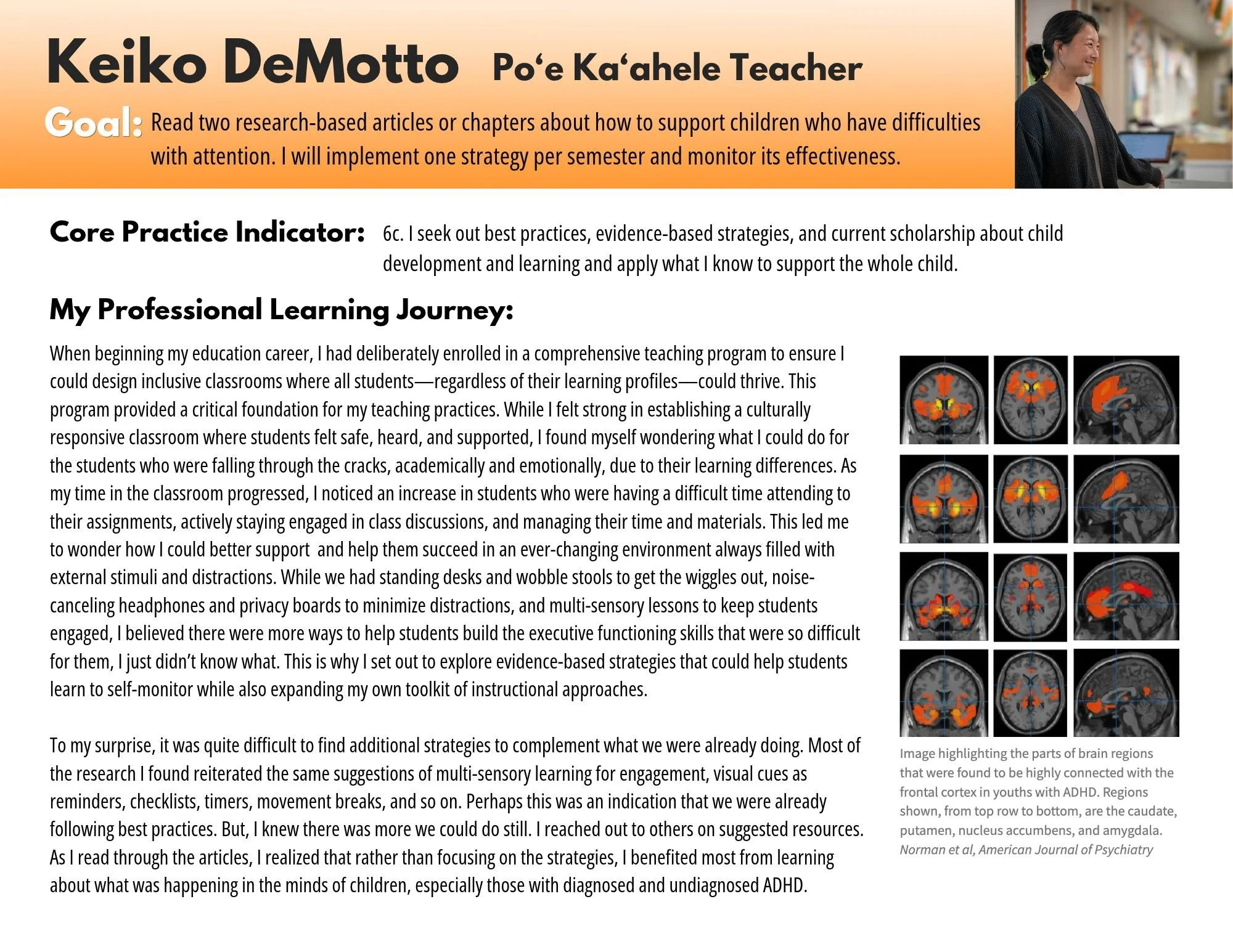
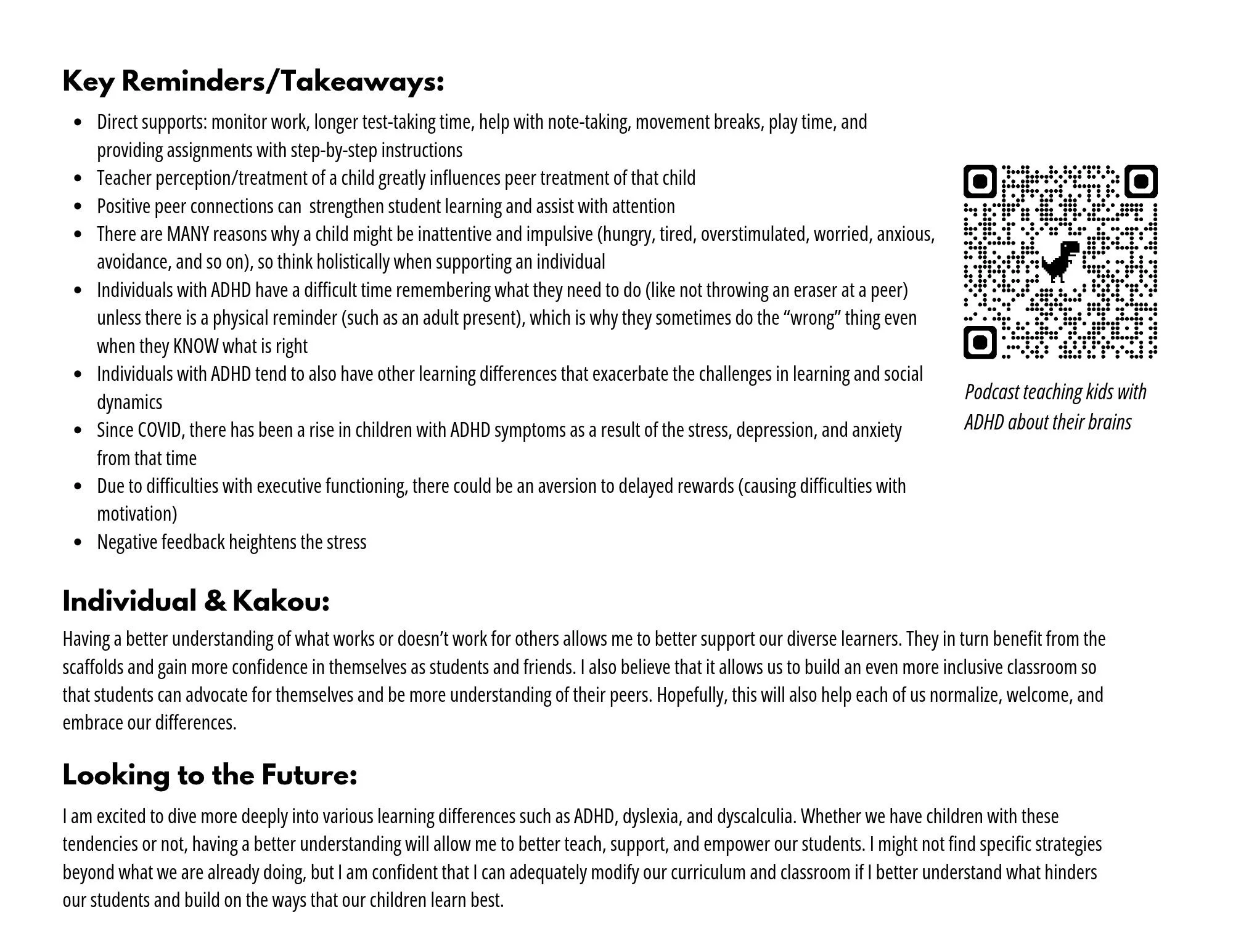
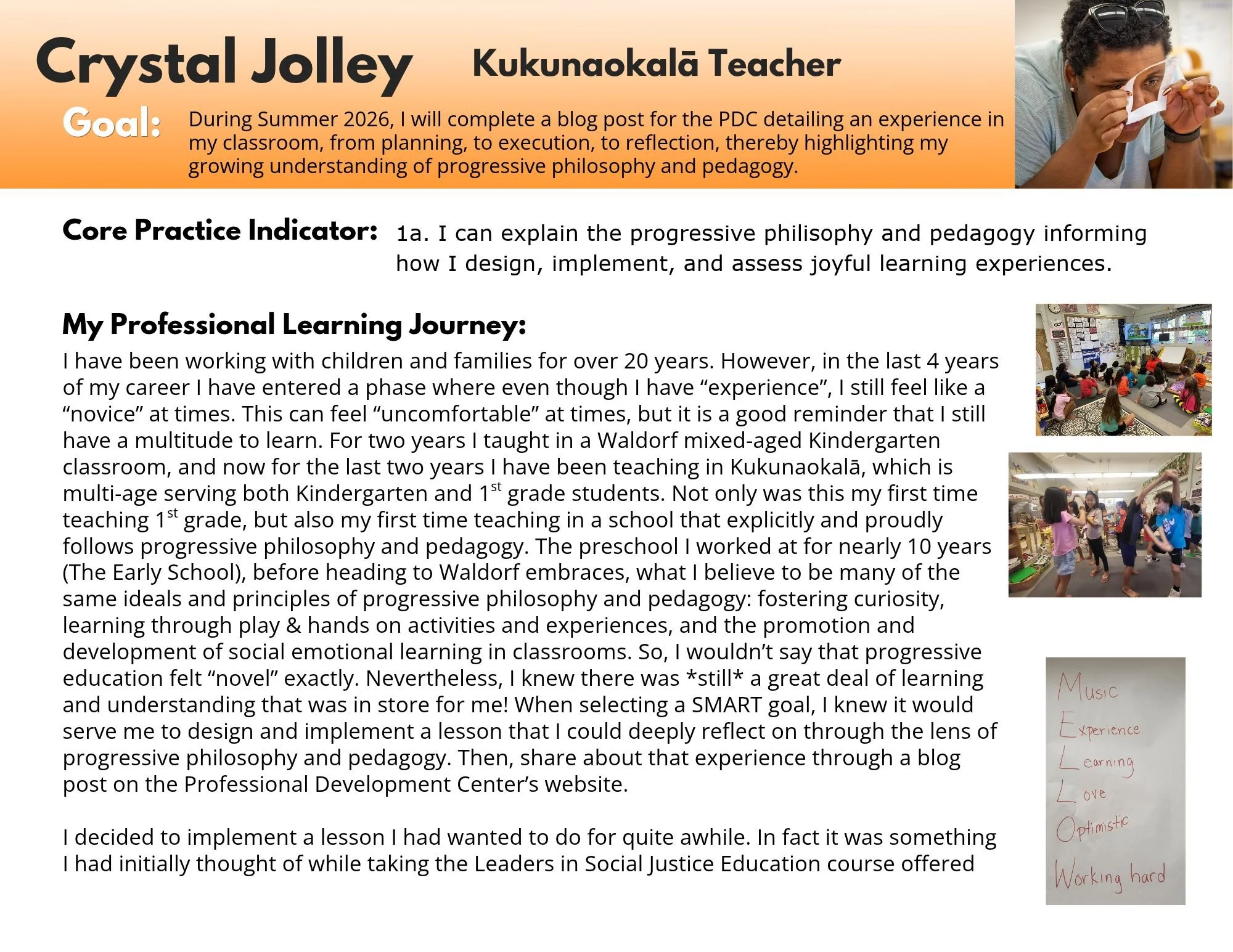
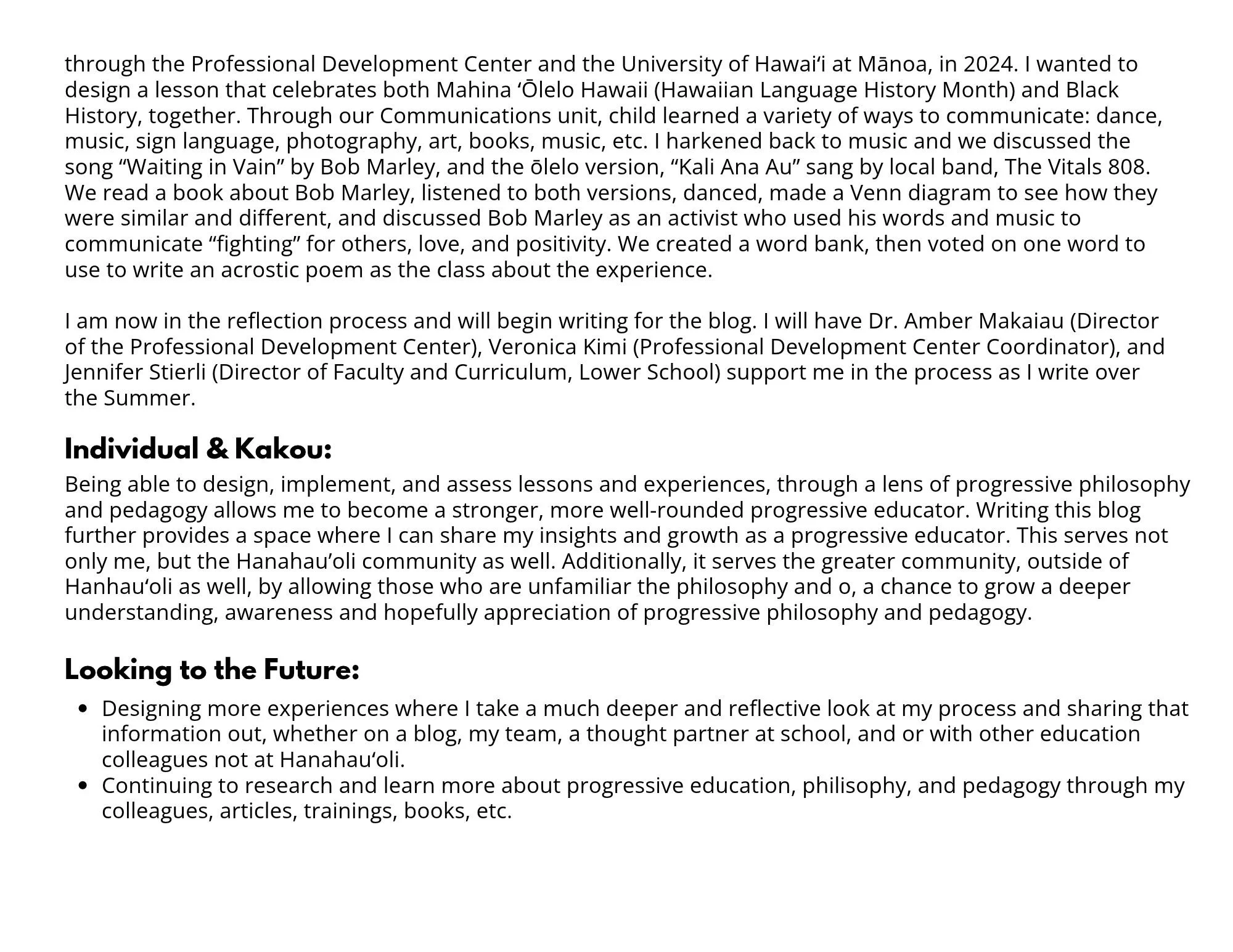
Using a provided Canva template, each faculty member designed a poster that included their:
Name
Goal
Core Practice Indicator of focus
1-3 paragraph summary of the professional learning journey experienced, focusing on this goal
3 or more pieces of visual evidence to illustrate progress made on the goal. This could include student work, work products developed, photographs, etc.
Individual & Kakou: 1-2 sentences that explain how one’s individual growth supports the community.
1-sentence summary of possible next steps
Each faculty member’s display was then hung in the Hanahau‘oli School art gallery for our school community and campus visitors to enjoy from May through July. The gallery exhibition was also used to facilitate a faculty-wide reflection during the faculty in-service days dubbed “Week After Children”.
Here are some examples of the faculty displays:
Conclusion
In the 2026-27 school year, we are excited to continue refining how we will use the Core Practice Indicators to stimulate and guide Hanahau‘oli School faculty evaluation and growth. Ultimately, this process has affirmed for us that when evaluation is rooted in shared values rather than top-down compliance, it becomes a catalyst for genuine professional growth and collective ownership. We know this is an ongoing journey, and we are grateful to our entire faculty for leaning into this work with vulnerability, curiosity, and care. If your school or organization is reimagining what meaningful, human-centered teacher evaluation can look like, we would love to hear what you’re learning along the way!
Works Cited:
Bleiberg, J., Brunner, E., Harbatkin, E., Kraft, M. A., & Springer, M. G. (2021). The effect of teacher evaluation on achievement and attainment: Evidence from statewide reforms (EdWorkingPaper No. 21-496). Annenberg Institute at Brown University.
ABOUT THE CONTRIBUTOR:

Dr. Amber Strong Makaiau is a Specialist at the University of Hawai‘i at Mānoa, Director of Curriculum and Research at the Uehiro Academy for Philosophy and Ethics in Education, Director of the Hanahau‘oli School Professional Development Center, and Co-Director of the Progressive Philosophy and Pedagogy MEd Interdisciplinary Education, Curriculum Studies program. A former Hawai‘i State Department of Education high school social studies teacher, her work in education is focused around promoting a more just and equitable democracy for today’s children. Dr. Makaiau lives in Honolulu where she enjoys spending time in the ocean with her husband and two children.

