
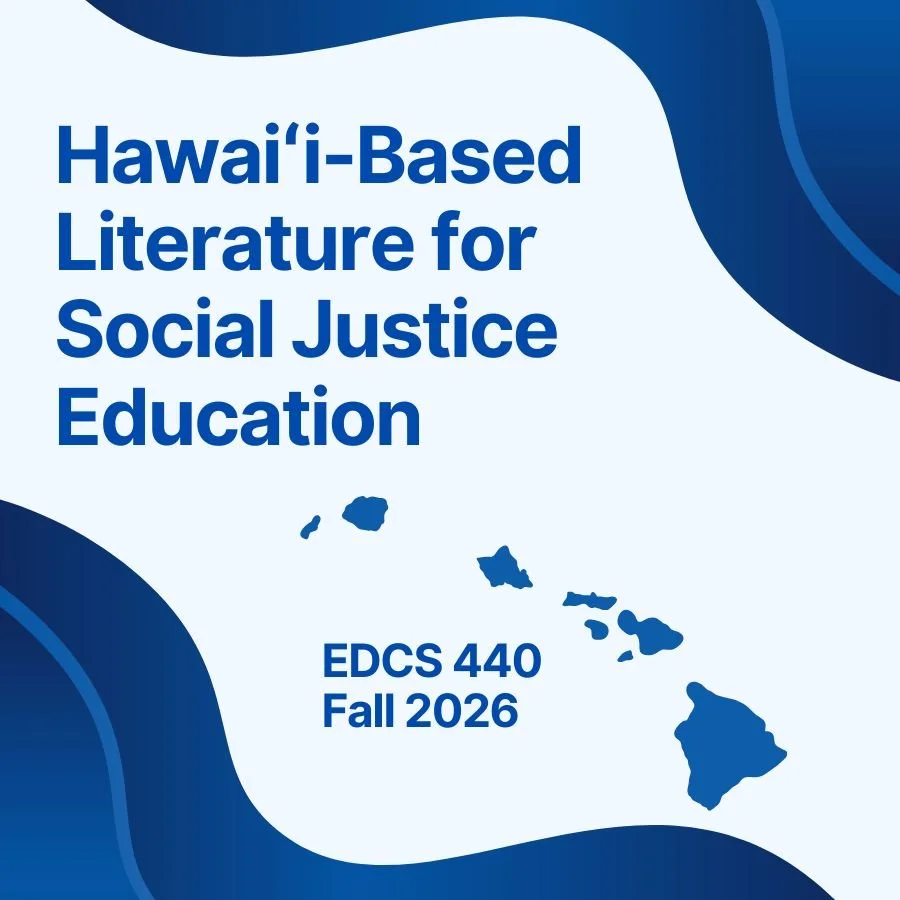
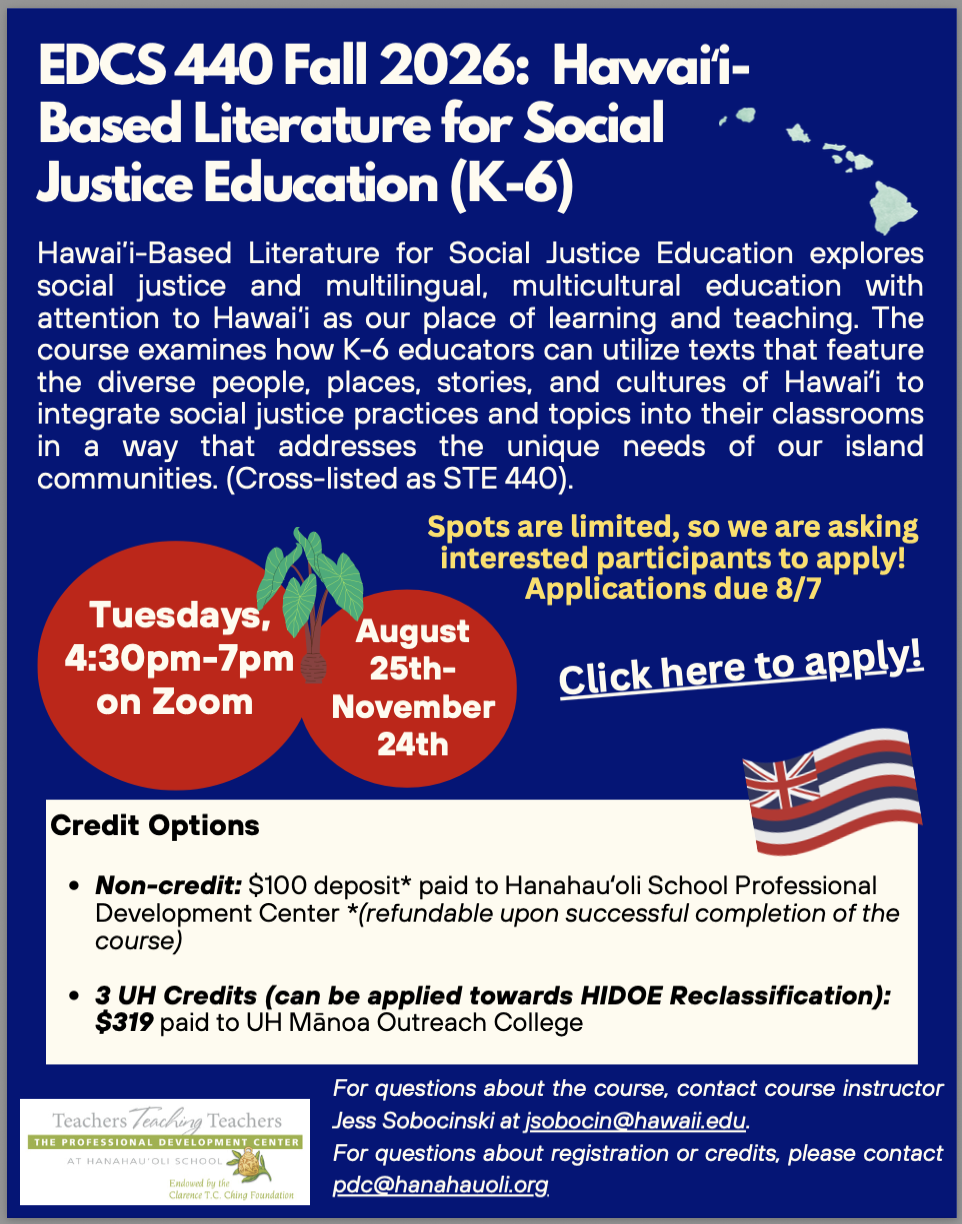
Tuesdays, 8/25-11/24
4:30 to 7:00 pm
Online via Zoom
$319 for 3 UHM credits or $100 refundable deposit if not pursuing credits
This course examines social justice and multilingual, multicultural education, with attention to Hawai‘i as our place of learning and teaching. Over the course of the fall semester, participants will explore ways to utilize texts that feature the diverse people, places, stories, and cultures of Hawaiʻi to integrate social justice practices and topics into the K-6 classroom in a way that addresses the unique needs of our island communities.
Participants can expect to engage in robust discussions about the landscape of social justice education in Hawai’i; learn research-based teaching practices and how those practices intersect with Hawaiian-focused education and ʻāina-based learning; and investigate strategies for incorporating age-appropriate texts to support social justice education across multiple subject areas. The instructor will share examples of how they have applied Hawai’i-based texts in their own classrooms, in alignment with their grade-level content standards and curriculum. The course will culminate in a project in which participants will create a lesson, text, or other project that applies literature as a tool to teach about social justice in a Hawaiʻi context.
Course participants will meet virtually over Zoom. Before applying, please review the following course meeting dates and course requirements carefully to ensure you can fully participate.
Dates: August 25 - November 24, 2026 (Tuesdays, 4:30pm-7pm)
Requirements:
2 academic reading assignments per week w/short reflections
Social Justice School/Classroom audit assignment
Personal Social Justice Bibliography assignment
Final Project Plan Draft
Final Project Presentation
Attendance at course meetings (2 excused absences are allowed)
Participants are eligible for 3 credits through UH Mānoa Outreach College.
Workshop Objectives:
Participants will:
become well-versed in the current research and best practices for facilitating place-based social justice education in their classrooms.
cultivate a deeper understanding of how Hawai’i’s unique history and current geo- and socio-political contexts shape social justice issues in our island communities.
understand the essential role that place-based, culturally-relevant literature can play in social justice education in Hawaiʻi.
be able to apply Hawaiʻi-based texts to lead place-based multidisciplinary lessons and/or activities with their students in alignment with their grade-level content/subject area standards.
ABOUT THE FACILITATOR

Jess Sobocinski, MEd is an educator and researcher living in the ahupuaʻa of Kealakekua, Hawaiʻi Island. Originally from Portage, Indiana, she discovered her passion for education through work in food hubs, where she saw the potential of community gardens to foster healing and address social inequality. After serving as a garden kumu at Hōnaunau Elementary and earning her K-6 teaching license through Kahoʻiwai, Jess has worked in farm-to-school programs across Hawaiʻi Island for over a decade. As a graduate student in the MEd CS STEMS² program at the University of Hawaiʻi at Mānoa, her research focused on using ʻāina-based education to promote social justice education in elementary schools, empowering students to recognize and address injustices while developing empathy and resilience. Jess has returned to her roots at Hōnaunau Elementary, serving as a first grade general education teacher!
THIS WORKSHOP IS INTENDED FOR
K-6 general education teachers, special education teachers, librarians, counselors, reading specialists, and other resource teachers who regularly incorporate picture books, literature, and other text resources into their curriculum.