Friday, September 25, 2026
8:30 am - 12:30 pm
Hanahau‘oli School Professional Development Center, 1922 Makiki Street, Honolulu, HI 96822
Free!
This interactive workshop is designed for educators seeking practical ways to build student voice, civic engagement, and leadership in their classrooms and school communities. Examples include:
Facilitating Student-Led discussions or debates on real-world issues
Creating classroom or school-based civic action projects
Connecting classroom learning to local or state-level civic opportunities
Developing structured opportunities for students to take on leadership roles
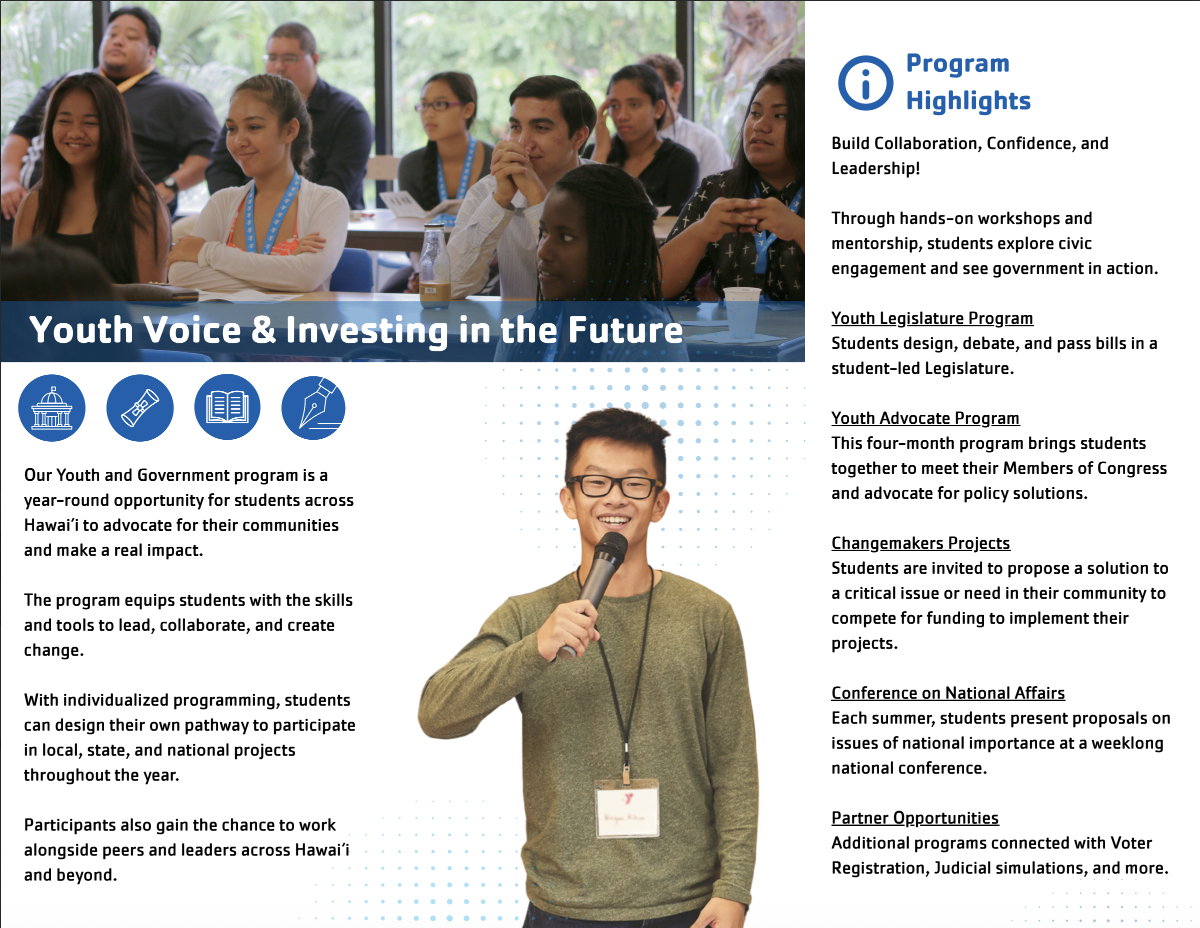
Drawing on the YMCA Youth & Government model, participants will explore proven strategies for developing student agency through parliamentary procedure, project-based civic action, and student-led decision-making. While the model was designed for middle and high school settings, elementary educators are welcome to attend and find ways to apply the framework to younger learners.
Educators who attend this workshop will leave with a ready-to-implement civic engagement plan tailored to their context, along with an adaptable curriculum, facilitation strategies, and connections to statewide Youth & Government opportunities.
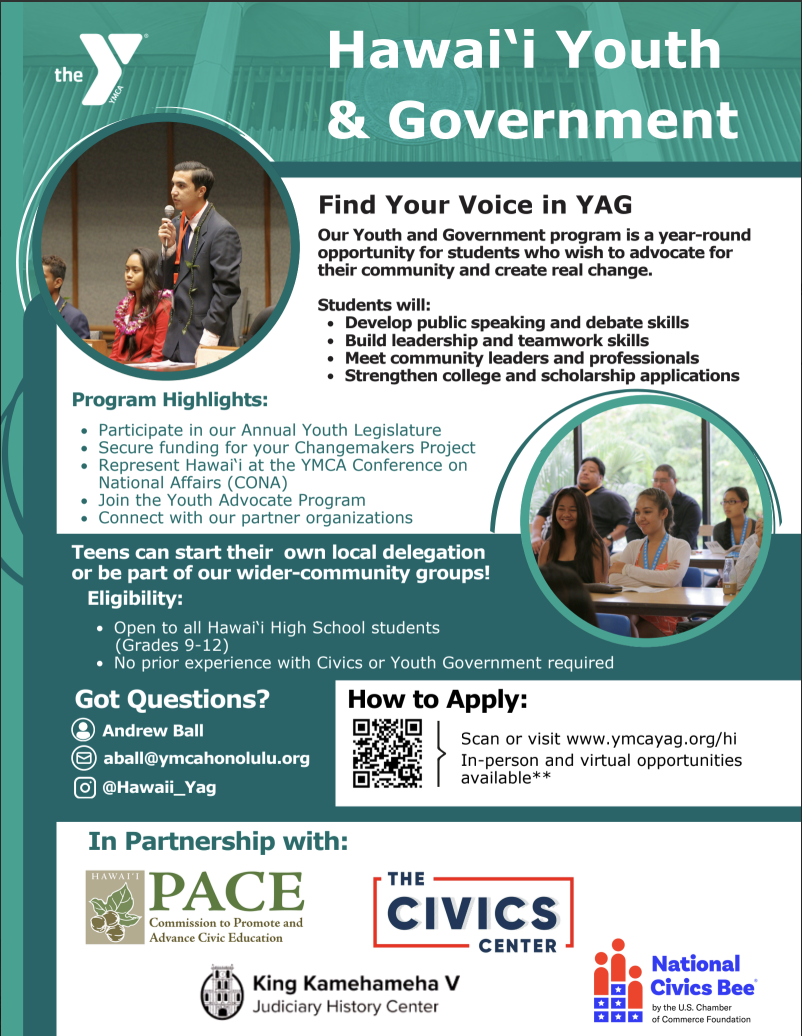
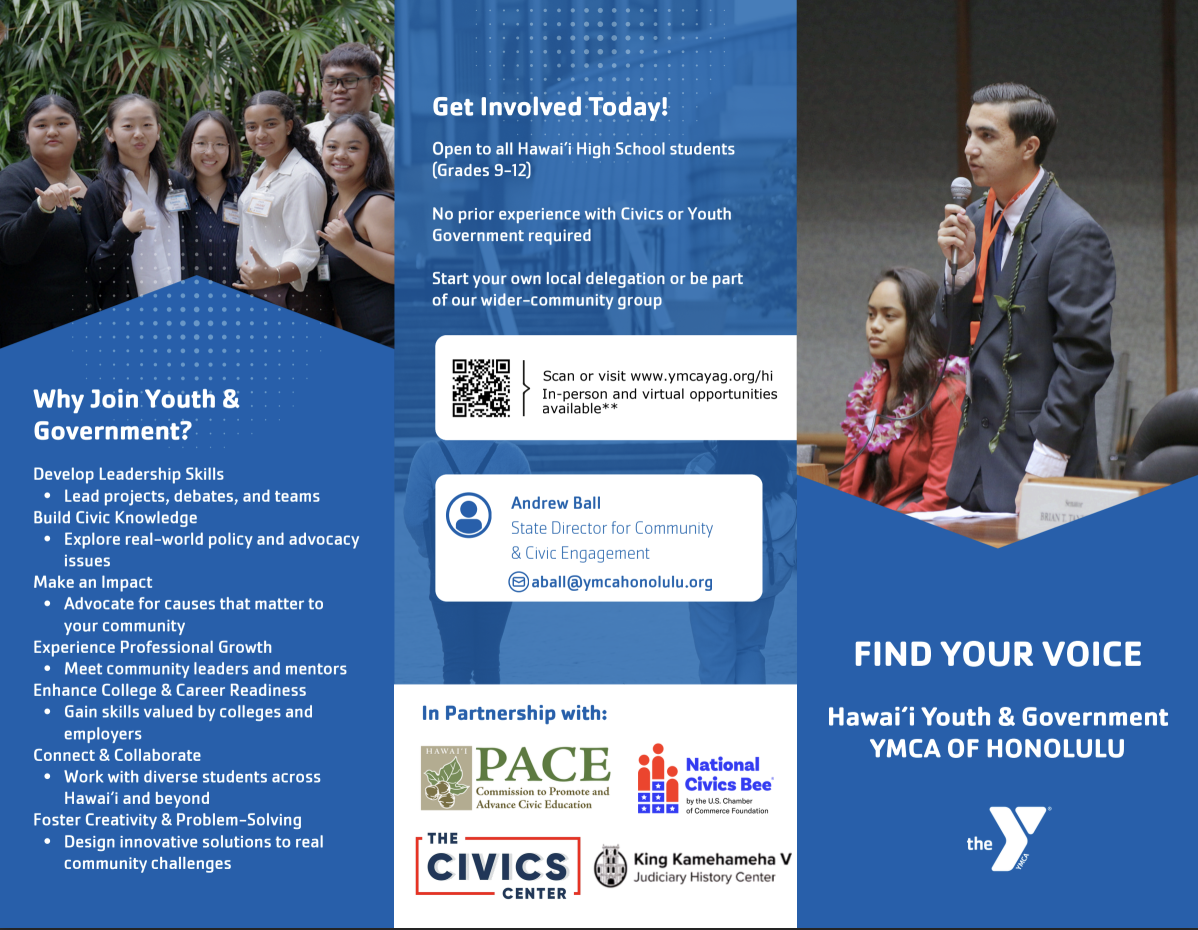
Download PDFs of the Youth & Government flyer and brochure.
WORKSHOP OBJECTIVES
Participants will be able to:
Identify key strategies to promote student voice and civic participation
Facilitate a structured student-led discussion or parliamentary activity
Design a civic engagement project or unit plan aligned to their classroom or school context
WORKSHOP AGENDA
Part 1 - Civic Voice & Parliamentary Skills
8:30 - Needs Assessment & Participant Introductions (20 minutes)
Participants are given a template to reflect on their current practice and needs within their community related to Civic Voice and Action, as they arrive
Participants will then share their backgrounds and why they wanted to participate in the workshop
8:50 - YMCA Youth & Government Model (20 minutes)
Participants will engage with video and supporting resources related to the YMCA Youth & Government 2026 Model Youth Legislature. This will include an overview of the program, student testimonials, products, and the sample sessions
Participants will be asked to assess the program based on key questions
9:10 - Mock Legislature (40 minutes)
Using our simplified script and example Bills provided by students, participants will have the opportunity to participate in a Mock Legislative session
They will initially look to prepare this in small groups, reviewing the materials before working as a larger group to complete this
The group will reflect on and debrief the experience
9:50 - Guiding Principles (30 minutes)
In groups, participants will explore samples of pedagogical approaches related to Culturally Responsive Teaching, Student-Centered, Project-Based, and Self-Directed Learning
Using the examples from the session and key content, the group will establish a set of key principles to use. This can then be adapted to participants' work in their community. This will focus on how they can elevate student voice, deploy parliamentary skills, and engage students
10:20 - Break (10 minutes)
Part 2 - Student-Led Civic Action & Leadership
10:30 - Barrier Identification (15 minutes)
Participants will work in small groups to identify the key barriers to student-led civic action within their community
10:45 - YMCA Changemakers Project (20 minutes)
Participants will be introduced to the Changemaker Project, where they will have the opportunity to consider the impact of their barriers on the successful uptake of the project
11:05 - Supporting Student-Led Initiatives (25 minutes)
Provided with a framework and key examples related to Changemakers, as well as partner projects, participants will look to develop solutions to the barriers identified earlier in the session
Further categorization of the solutions will consider who holds the responsibility for this, the required steps to follow, and the impact on student engagement
11:30 - Project Building (30 minutes)
In either small groups (related fields or same context) or individually, participants will design a piece of work supporting Civic Voice & Parliamentary skills in their own context
Prompts and example opportunities will be provided for this, with staff looking to set objectives, outline steps for implementation, and define student roles
12:00 - Reflections & Next Steps (20 minutes)
Participants will have the opportunity to share their projects and help to support one another with the application of key learning theory and questions, solidifying their solutions.
Participants will then reflect on what they learned to consider their ‘ideal’ education setting to support Civic Engagement and Education
12:20 - Final YMCA Youth & Government Opportunities (10 minutes)
Finish presenting and offering next steps, which can connect staff and students to programming, curriculum, and opportunities with the YMCA
ABOUT THE FACILITATOR

Andrew Ball is the State Director for Community & Civic Engagement with the YMCA of Honolulu, where he leads YMCA Youth & Government programming across Hawai‘i. In this role, he supports student leadership and civic engagement opportunities at the local, regional, and national levels, partnering with middle and high schools to design and deliver programs that empower young people to develop their voice, engage in civic processes, and take action within their communities. Andrew brings experience across a range of educational settings, having worked as a Social Studies teacher, Regional Department Lead, and Grant Director in the United Kingdom and the United States. He has supported educators and community partners in developing student-led learning, parliamentary procedure, and project-based civic initiatives that create meaningful, real-world learning experiences. He is passionate about creating spaces where young people can lead, contribute, and shape the communities around them through student-led and culturally responsive practices.